Outcome Measurement
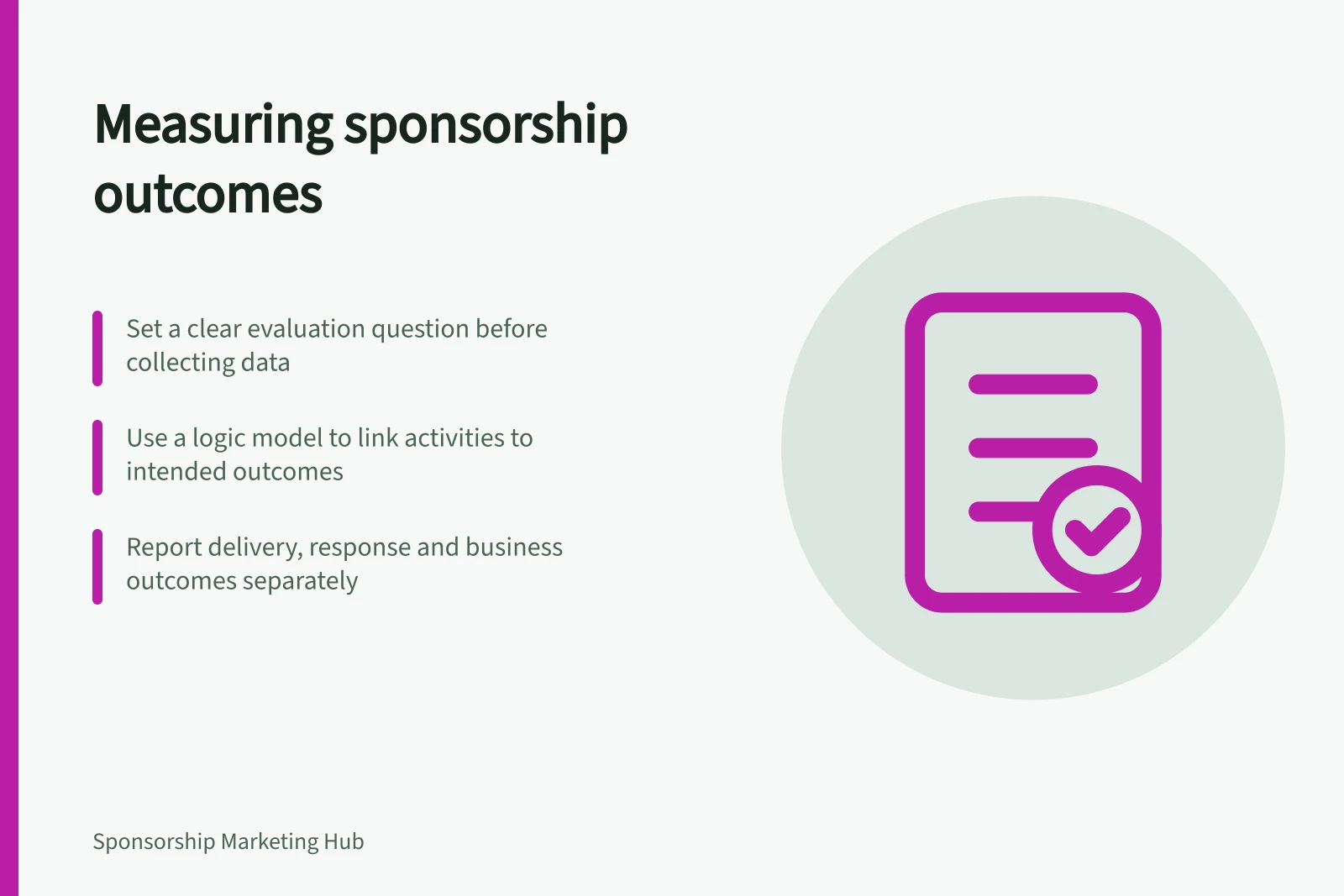
Measuring sponsorship outcomes
Measure sponsorship delivery, audience response and business outcomes separately, then use the evidence to decide what to change.
Measure a sponsorship against the purpose that justified it. Confirm what the property and sponsor delivered, examine observable audience response, then consider any business outcome. A claim that the sponsorship caused a sales change needs stronger evidence. One reach figure cannot answer all these questions.
Choose the outcome before collecting numbers
Set one primary evaluation question about the people and decision that matter. Did the activity help people in the brand's service area recognise it? Did it prompt relevant enquiries? Did it fulfil a stated community commitment? Each question needs different evidence.
Keep the intended audience and period specific. An event-exit survey cannot establish recognition across a whole city without a suitable sampling design. An enquiry count may suit a sales objective but say little about community benefit.
Choose a few measures that could change a decision. Record the starting point where needed, the collection method, the person responsible and when results will be reviewed. If a baseline or useful comparison is unavailable, record that limit before the activity starts.
Key Steps Before Collecting Sponsorship Measurement Data
- Define one primary evaluation questione.g., Did the sponsorship increase brand recognition in the target service area?
- Specify audience and time periodEnsure sampling design reflects the intended population
- Record baseline or comparison dataDocument starting point before activity begins
- Assign responsibility and review datesClarify who collects data and when results will be reviewed
Map the expected contribution
A simple logic model can make the evaluation question more precise: describe what the sponsorship is expected to do, how its activities are meant to lead to an outcome, and what evidence would indicate progress. Use it to check that the measures relate to the intended outcome rather than stopping at activity counts.
Agree the evaluation objectives with the stakeholders who will use the findings. Document their information needs and intended use, and consider whether different stakeholder groups have interests or views that should be reflected in the evaluation.
Select monitoring and evaluation approaches to suit the purpose and activity; use complementary methods when needed, and seek suitable expertise if the question requires skills or knowledge not available within the team.
Report three layers separately
| Layer | Question | Possible evidence | Limit |
|---|---|---|---|
| Delivery | Did the agreed rights and activities run? | Published copies, dated placement records, activity logs | Delivery does not establish attention. |
| Response | What did people notice or choose to do? | Survey answers from a defined group, voluntary interactions, identifiable enquiries | Respondents and participants may differ from the wider audience. |
| Business outcome | What happened during the chosen period? | Qualified opportunities or recorded sales | An observed outcome is not automatically caused by sponsorship. |
Do not add attendance, video views and social followers into a count of unique people reached. The groups may overlap, and none necessarily saw a sponsor asset. State what each figure counts and its reporting period.
Report material rights individually. A cancelled demonstration and a delivered sign should not become one statement that the package 'ran'. Keep sponsor-produced work distinct from what the property promised to supply.
Measuring Sponsorship Outcomes: Three Layers to Report Separately
- Layer 1: DeliveryDid the agreed rights and activities run?
- Layer 2: ResponseWhat did people notice or choose to do?
- Layer 3: Business OutcomeWhat happened during the chosen period?
Consider outcomes over time
Separate short-term from longer-term outcomes where that distinction matters to the decision. Consider unintended outcomes as well as intended ones; an evaluation can assess both, rather than treating the stated objective as the only result worth noting.
The Australian Centre for Evaluation describes impact broadly as outcomes, including short- and long-term, intended and unintended outcomes. This helps keep a report focused on what changed or occurred, while reserving causal claims for evidence that can support them.
Short-Term vs Long-Term Sponsorship Outcomes
- Short-Term Outcomes
- Immediate awareness, engagement, enquiries
- Long-Term Outcomes
- Brand loyalty, sustained community support, lasting behavioural change
Match the method to the question
For recognition, use a neutral question with a defined group. Detailed recall survey design is covered in S019-P14-S02.
For enquiries, define a useful enquiry before counting. Record the requested next step and the relevant customer need. A sponsorship-specific destination or tagged link can identify a recorded route to the site when tracking is configured. It cannot capture every offline encounter or prove that sponsorship alone caused a later purchase.
For a community purpose, document the promised support, what the organiser received and what it could do with it. If the property is a registered charity, discuss the review with its responsible people and keep its charitable purpose and capacity in view. Do not turn a delivery record into an unsupported claim about wider community impact.
Check the quality of the evidence
A sample may not represent the population the sponsor wants to understand. The Australian Bureau of Statistics identifies sampling error when sample characteristics differ from the population, when a sample is too small, or when selection is not random. Sampling error can be measured and controlled in random samples when each unit has a calculable chance of selection.
Also consider non-sampling error, which can affect either a sample or a complete count. Coverage problems, non-response and inaccurate answers can all make collected data a poor reflection of the underlying value. A large response count alone does not resolve these problems.
Describe the important limitations alongside the result. For example, explain who was missed, whether some selected people did not respond, and whether questions or instructions might have been misunderstood. Treat these as evidence-quality issues, distinct from whether the sponsorship itself performed well.
Evidence Quality Considerations in Sponsorship Evaluation
- Sampling Error
- Occurs when sample is too small or selection isn't random
- Non-Sampling Error
- Includes coverage issues, non-response, inaccurate answers
- Reporting Limit
- Always state limitations alongside results
Be careful with causal claims
Sales can change because of other campaigns, distribution, price or seasonality. A before-and-after movement alone cannot isolate the sponsorship's effect. If the decision requires an estimate of incremental sales, plan a credible comparison before launch and seek suitable evaluation expertise. A group that did not attend an event may differ from attendees in other ways that affect sales.
For a smaller partnership, a descriptive report may be sufficient. State what was observed, what was missing and which other influences were present. If an analytics platform assigns credit to a campaign, describe the result under its attribution method. Do not present that credit as an estimate of sales that would not otherwise have occurred.
Using Analytics Platforms for Attribution: Pros and Cons
- Pros
- Provides measurable touchpoints; useful for tracking digital journeys via tagged links
- Cons
- Cannot prove causation; attribution models assign credit but don’t isolate incremental impact
Turn the report into a decision
Review delivery while missed items can still be corrected, then review response after the agreed observation period. Put the original purpose beside the results. Separate an activity that drew little response from one that was never fully delivered, and weak evidence from evidence of a weak response.
Decide whether to repeat the activity, change a right or audience experience, improve measurement, narrow the package or stop. Record the evidence and limits behind that choice so the next sponsorship starts with a clearer question.
Use evidence that fits the evaluation purpose
Before signing off, check whether the findings answer the documented evaluation questions and give decision-makers the information they need for the stated use; note any question the evidence cannot answer.
In this guide
- Measuring recall separately from sales attributionReport sponsor recall and recorded sales separately, with clear survey groups, tracking methods and attribution limits.
- Tracking the use of sponsorship rightsTrack which sponsorship rights your team actually used, why planned uses changed and how that affects the outcome review.
- Designing a sponsorship evaluation before signingSet the sponsorship evaluation question, evidence, access, owners and reporting dates while the deal can still change.