Outcome Measurement
Part of Measuring sponsorship outcomes
Measuring recall separately from sales attribution
Report sponsor recall and recorded sales separately, with clear survey groups, tracking methods and attribution limits.
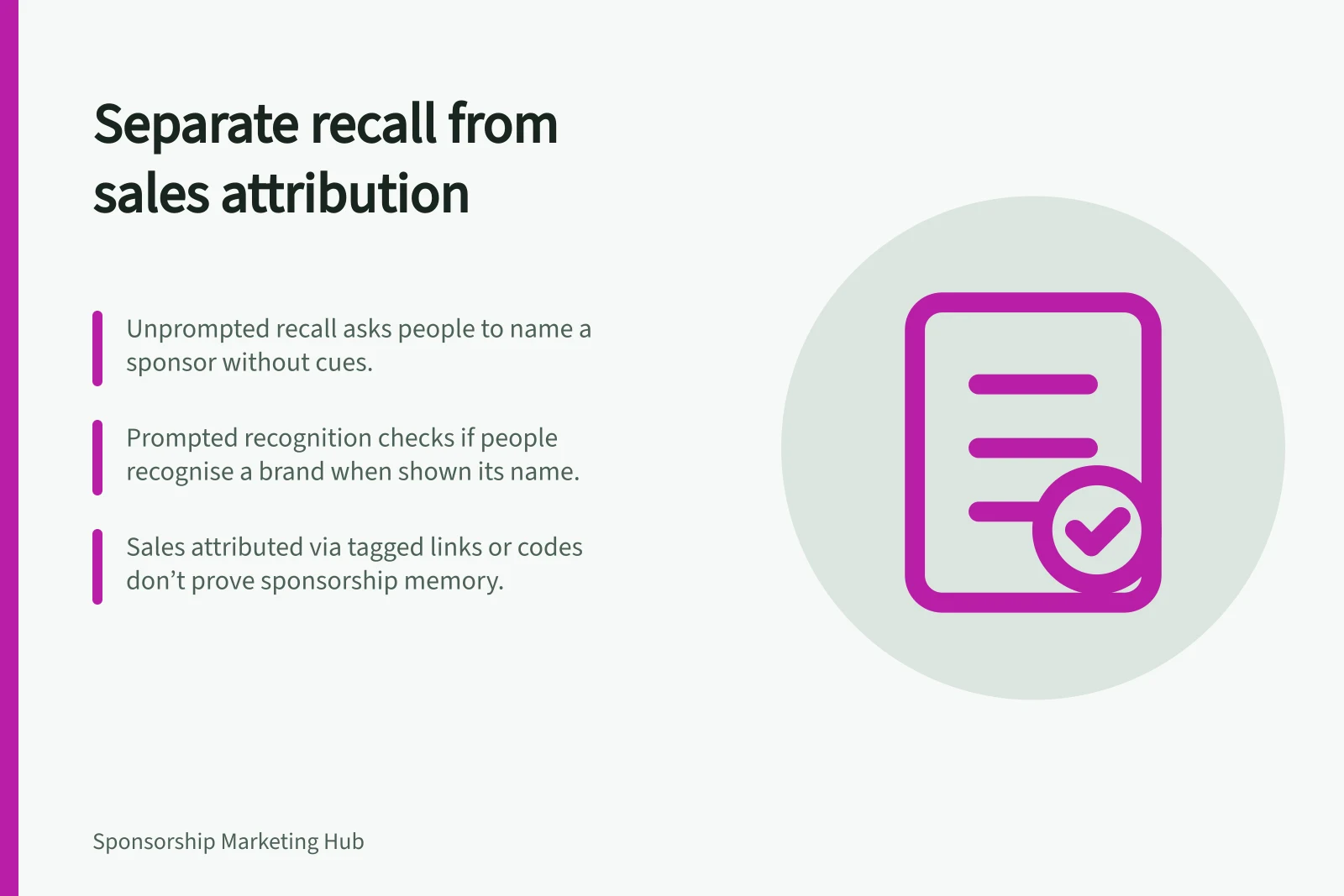
Sponsor recall asks whether people remember a brand in connection with an activity. Sales attribution assigns credit for a recorded action or sale to marketing touchpoints under a stated method. Report them separately: remembering a sponsor does not make someone a buyer, and an attributed sale does not show that the buyer remembers the sponsorship.
Define the recall result
Name the group the result is meant to describe: event attendees, people in the brand’s service area or prospective buyers in a defined market. Recruitment must suit that group. An exit survey offered only to attendees answers an attendee question, even if the campaign aimed at a wider audience.
State which measure you used. Unprompted recall asks people to name a sponsor before seeing brand names. Prompted recognition asks whether they recognise a brand when shown its name in a defined context. Memory of a particular demonstration or placement is another question. Do not combine these answers into one recall rate.
Record the exact question, response options, eligibility rule, recruitment method, dates and number of responses. Allow ‘don’t know’.
For a comparison over time, keep the question and recruitment method as similar as practicable. A changed mix of respondents can produce an apparent movement even when the wider audience has not changed.
Do not claim a result represents all attendees or residents merely because many people answered. State material limits such as self-selection and non-response beside the figure.
Key Metrics for Sponsorship Evaluation
- Recall Method
- Unprompted recall / Prompted recognition
- Survey Group
- Event attendees, service area residents, or target market segment
- Response Rate
- Reported with eligibility rules and recruitment method
Trace recorded sales carefully
Choose the action that matters: an enquiry, an accepted opportunity, a purchase or another completed step. Specify the reporting window and whether the figure counts people, orders or value. Account for refunds or repeat orders where they matter to the decision.
A tagged link from a sponsor post can identify traffic recorded through that route when the analytics setup captures the parameters. A promotion code or a customer’s answer about how they heard of the brand can add context. Each method misses some encounters and can include people influenced by other marketing. Keep the methods separate in the report.
If Google Analytics 4 assigns credit to a campaign for a key event, record the reporting attribution model and relevant settings. Attribution credit is not an estimate of how many sales would have happened without the sponsorship. Some site traffic also has no clear recorded referral source.
Steps to Accurately Report Sponsorship Impact
- Define the action that mattersEnquiry, accepted opportunity, purchase, or completed step
- Specify reporting window and metricCount people, orders, or value; account for refunds
- Use separate tracking methodsTagged links, promo codes, or customer survey data
- Record attribution model settingsEnsure transparency in how credit is assigned
Read the results together
Show the recall result for the surveyed group with its question, response count and recruitment method. Beside it, show identifiable enquiries or sales for the chosen period and how each was traced. Add a short record of which sponsorship activities ran.
| Possible observation | Careful reading |
|---|---|
| More respondents name the sponsor | Recall changed among those measured; check sample comparability before extending the finding. |
| Tagged visits increased | More recorded visits used the tagged route; this does not count every exposure or establish incremental sales. |
| Sales rose during the campaign | The business sold more in that period; other influences still need consideration. |
These are interpretations of hypothetical results, not findings from a campaign.
If the decision requires an estimate of incremental sales, design a credible comparison before launch and seek suitable expertise. A before-and-after chart provides context but cannot isolate cause when other factors may be changing.
If that design is impractical, report what the records show and leave the causal question open.
Sponsor Recall vs. Sales Attribution: Key Differences
- What it measures
- Memory of sponsorship (e.g., brand recognition after an event)
- How it's measured
- Survey responses: unprompted recall or prompted recognition
- Data source
- Respondent self-reporting (exit surveys, post-event polls)
- What it does not show
- Whether the person made a purchase or was influenced to buy
- What it measures
- Sales or actions linked to marketing touchpoints
- How it's measured
- Tracked via tagged links, promo codes, or customer survey responses
- Data source
- Analytics platform (e.g., Google Analytics 4), CRM records
- What it does not show
- Incremental impact beyond existing sales trends