Outcome Measurement
Part of Renewing or ending sponsorships
Building a decision record for a sponsorship renewal
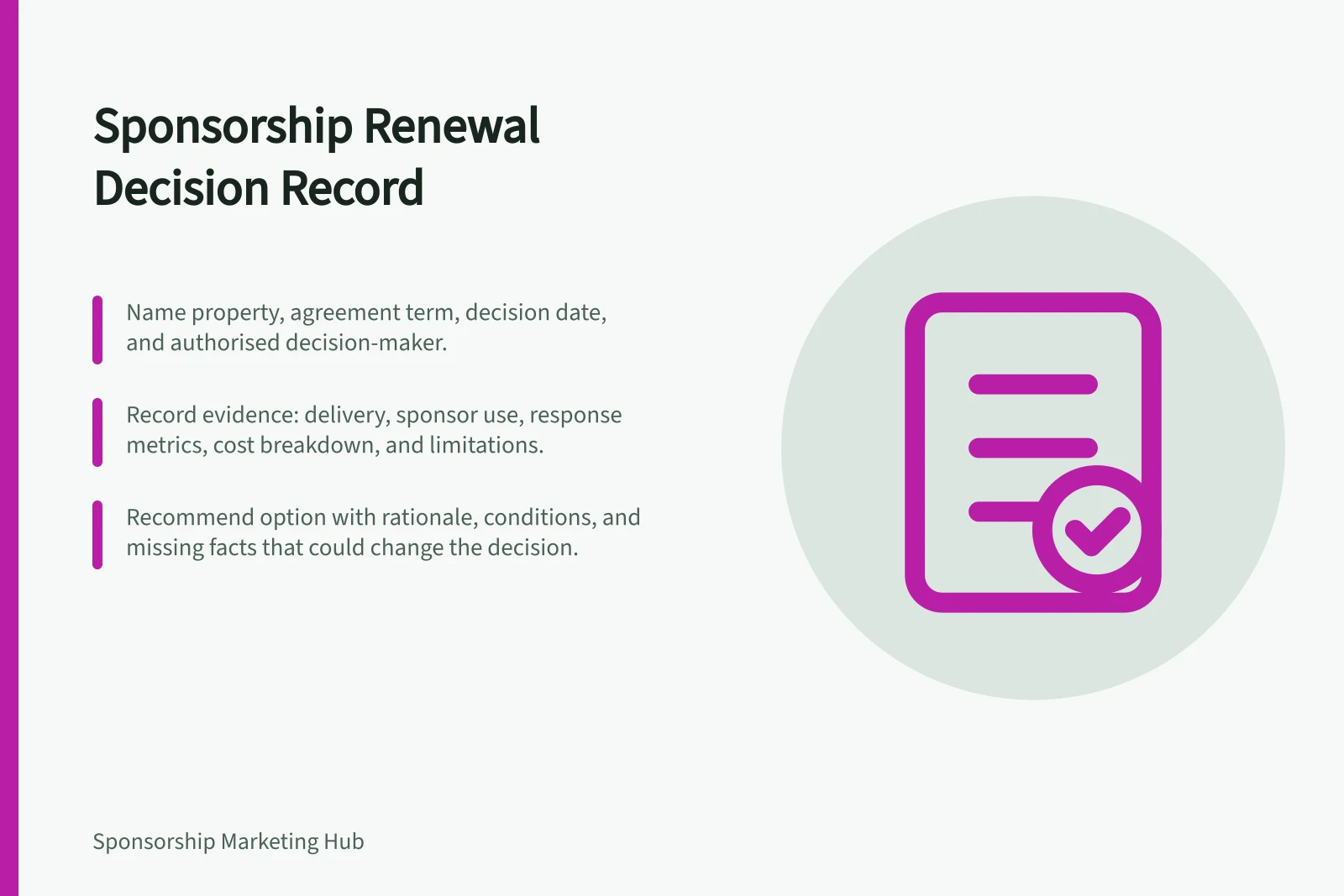
Record the renewal options, evidence, limits, costs, authority and next actions so the sponsorship decision can be traced.
A renewal decision record should let someone outside the meeting see what was decided, why, on which evidence and against which agreement version.
Keep the recommendation, uncertainty and authorised outcome separate. The record explains the choice; it does not replace the agreement or evaluation report.
Define the choice
Name the property, current agreement and term, internal decision date, any notice deadline and person authorised to decide. List the options actually available: renew as offered, propose narrower rights, seek a limited term or end under the agreement. A proposed concession is not an agreed option until the property accepts it.
State the business purpose for the next period. Say if it has changed since the original purchase.
Sound delivery does not require renewal when the business no longer needs the activity. Equally, one missed optional placement need not settle a decision about an otherwise useful program.
Make the evidence traceable
| Field | Record |
|---|---|
| Agreement and delivery | The relevant item, what ran and the supporting record. |
| Sponsor use | Whether an available right was used, unused or blocked. |
| Response | Measure, population, period and method. |
| Cost | Rights fee, production, staff work and material unknowns. |
| Limitation | What the evidence cannot establish or what changed during the term. |
Keep a copy or stable reference for each material record. Mark missing evidence as missing.
A tagged sale does not by itself prove incremental revenue. If a survey covered only volunteers at an event, place that population beside its finding.
Key Metrics for Sponsorship Evaluation
- Agreement Delivery
- List of delivered items and supporting records
- Sponsor Use
- Rights used, unused, or blocked during term
- Response Measure
- Population, period, method, and outcome (e.g., survey of event volunteers)
- Total Cost
- Rights fee + production + staff time + unknowns
Compare options on the same basis
For each available option, describe the essential rights, fee, sponsor work, delivery dependencies and evidence needed for a later review. Use the same cost basis throughout. A lower rights fee can still require more production or staff time.
Write the recommendation plainly: choose this option because these rights serve this purpose, subject to these conditions. Add the strongest reason against it. Where evidence is weak, state which missing fact would change the choice and whether it can arrive before a contractual deadline.
For a registered charity partnership, record the charity's stated purpose and delivery capacity as part of the discussion without speaking for its responsible people.
Sponsorship Renewal Options Comparison
- Option: Renew as offeredFull rights, agreed fee, no changes to delivery. Requires full commitment and alignment with current business purpose.
- Option: Propose narrower rightsReduced visibility or access, lower fee. May suit budget constraints but requires renegotiation with sponsor.
- Option: Seek limited termShorter duration (e.g., 6 months). Allows reassessment without long-term commitment.
- Option: End under agreementNo renewal. No further obligations. Ensure compliance with termination clauses in contract.
Record authority and next actions
Date the decision and identify who approved it. Record whether they accepted, changed or deferred the recommendation and why.
Identify the exact proposed schedule or notice instruction. If terms later change, retain the authorised amendment and its effective date without overwriting the earlier decision.
Finish with owners and dates for notice, negotiation, revised rights, payments and brand-use checks.
The decision record shows what the business authorised. Whether the parties have agreed new terms depends on their accepted documents and communications under the agreement.