Rights Agreements
Part of Renewing or ending sponsorships
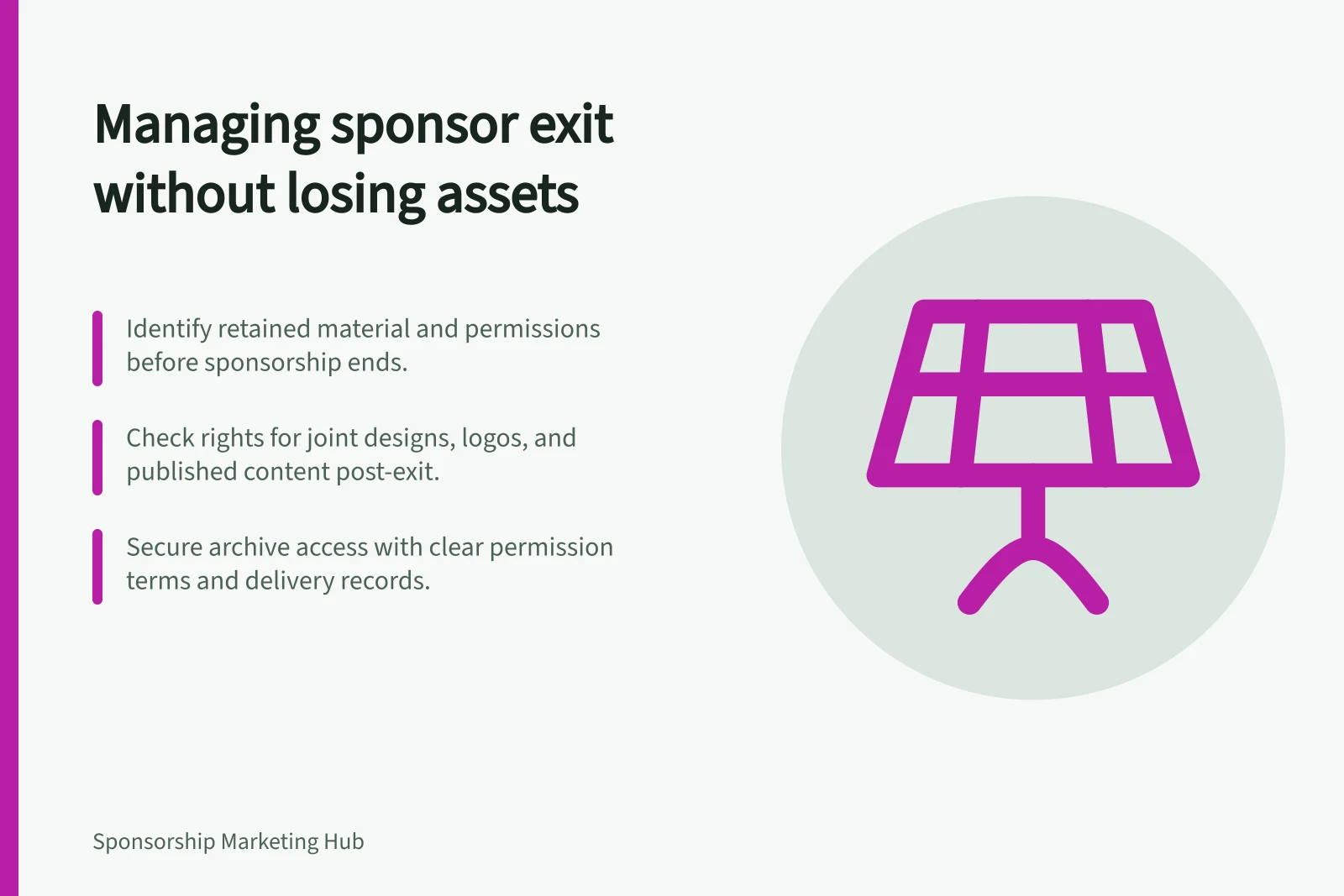
Managing a sponsor exit without losing licensed assets
Inventory sponsorship assets, check what may stay live after exit, and secure any archive or transition permissions you need.
Before a sponsorship ends, identify the material the team needs to retain and any permission for its next use. Holding a file differs from holding a licence to publish it. An exit plan should preserve usable records and files, stop uses whose permission is ending, and secure any archive or transition use the parties want.
Key Rights and Compliance Sources for Australian Sponsors
- Contract Preparation (Business.gov.au)
- Guidance on preparing contracts with contractors and suppliers
- Advertising Standards (ACCC)
- Rules on truthful advertising and promotional claims in Australia
- IP Licensing (IP Australia)
- Information on licensing intellectual property in Australia
- Copyright & Rights Management (IP Australia Blog)
- Updates on copyright licensing and rights organisations in Australia
Build the exit inventory
List live, queued and stored material: property names and marks, sponsor logos supplied to the property, photographs, footage, copy, joint designs and campaign files. For each item, record where the usable version is held, who can access it, the rights holder, the permission relied on, permitted user and use, and any end date. Include agencies and suppliers that hold copies or schedule publication.
One design may contain several assets with different rights holders. Approval of the finished design does not necessarily grant every underlying permission. Check the relevant agreements and approvals before relying on a photograph, footage, mark or person's image for another use.
| Asset state | Exit action to decide |
|---|---|
| Sponsor-owned working file | Keep an accessible copy and check third-party content within it. |
| Licensed property mark | Check whether planned new use is covered after the sponsorship ends. |
| Published joint creative | Check continued display, editing and archive terms separately. |
| Supplier-held material | Give the supplier a clear instruction about permitted future use. |
Asset State and Required Exit Actions
- Sponsor-owned working file
- Keep an accessible copy; check third-party content within it
- Licensed property mark
- Check if new use is covered after sponsorship ends
- Published joint creative
- Check continued display, editing and archive terms separately
- Supplier-held material
- Give the supplier a clear instruction about permitted future use
Reconcile material that will remain visible
Inspect live pages and profiles, scheduled posts and advertisements, event recaps, sales decks, templates and print stock. Record who controls each item, its next publication or distribution date, and the action required. A queued post can publish after permission ends even if its artwork was approved earlier. A live page may also describe the business as a current sponsor after the relationship ends.
Do not assume that every historic post must be deleted or every archive can remain. Check the applicable licence for existing displays, new distribution and print stock. Where important treatment is unclear, seek a decision from the relevant rights holder. If discussions about a future deal are underway, check the agreement for whether current permissions continue and on what terms.
Secure what is worth keeping
Decide whether the business needs an archive, case study, final campaign period or production files. Request any necessary permission for the specific asset, wording, channel, period, edits and supplier use. An archive permission should describe a past relationship accurately without implying that sponsorship continues.
Obtain agreed final files and delivery records while the relevant contacts are available. Keep approved versions and permission records together so a later team can tell which material it may use.
Close the public relationship
Agree on the end date and any closing statement. Replace current-sponsor or exclusivity claims where they no longer describe the arrangement. Review public claims for accuracy and make corrections where needed. Assign owners to check each party's controlled channels and handle corrections.
Close each inventory row as retained with permission, retained for internal record only, replaced, removed from current use or awaiting rights decision. Keep the action, date and authority beside the file.