Rights Agreements
Part of Renewing or ending sponsorships
Negotiating a narrower package after weak results
Diagnose weak sponsorship results, retain rights with a clear use and agree a smaller package with explicit delivery terms.
Propose a narrower sponsorship when the evidence points to a few useful rights and others the sponsor cannot justify or use. Explain what underperformed, what remains uncertain and what the next package must enable.
Weak results alone do not prove every right lacks value or entitle either party to a lower fee.
Key Considerations When Adjusting Sponsorship Scope
- Evidence-based decisions
- Do not reduce fees solely due to weak results; assess individual rights.
- Audience fit matters
- Poor engagement may stem from mismatched demographics, not poor rights.
- Measurement gaps require action
- If data is insufficient, request improved reporting or propose a trial period.
- No automatic discount
- Removing a deliverable reduces workload but does not mandate a price cut.
Diagnose the weak result
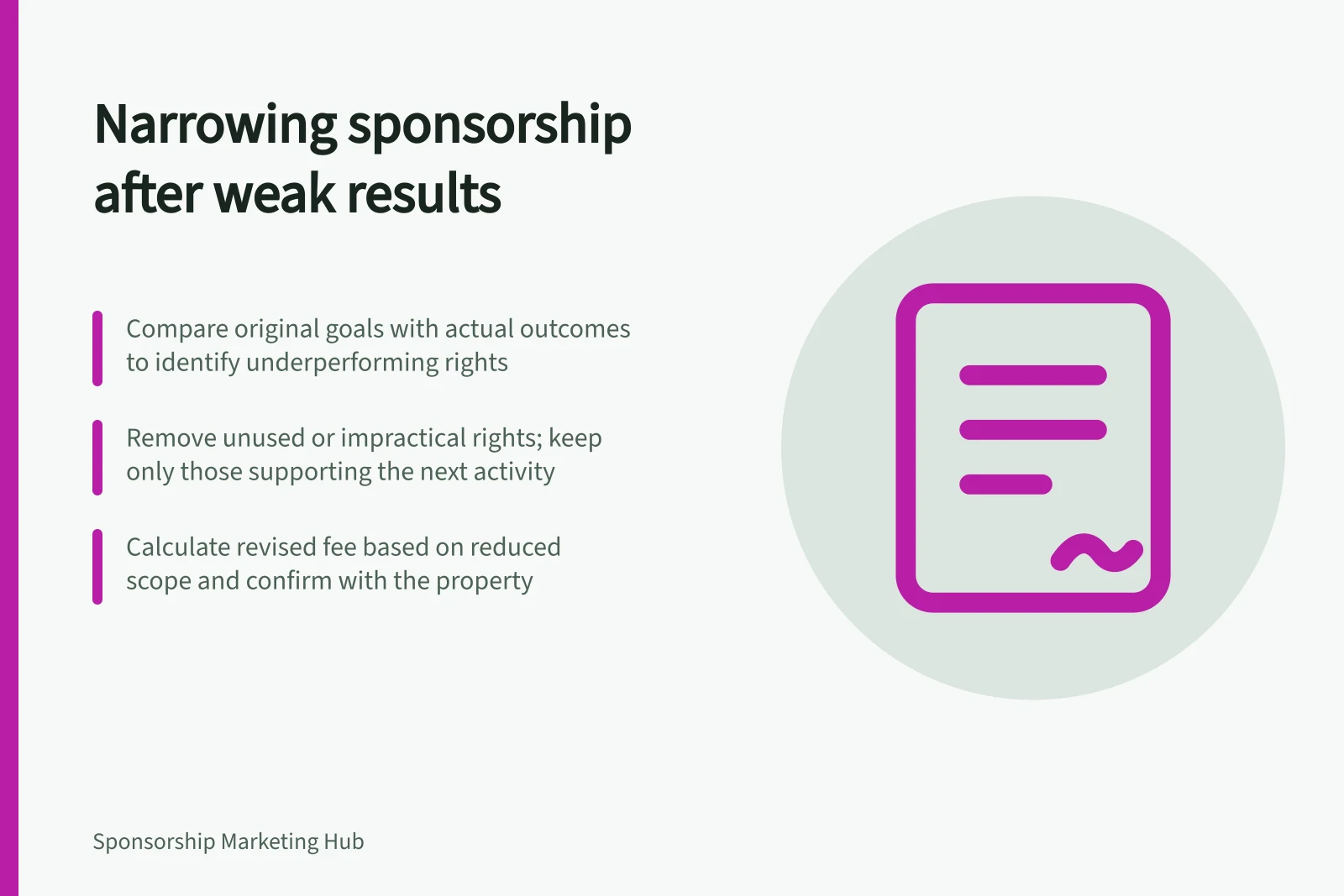
Compare the original purpose with the agreed schedule and what happened. Mark each material benefit as delivered and used, delivered but unused, changed or missed, or not evidenced.
A low enquiry count from an activity that ran differs from a low count when that activity was cancelled. Neither count alone establishes the sponsorship's effect on sales.
Ask whether the problem may lie in audience fit, the purchased right, execution, capacity or measurement. State which explanation the records support.
If evidence for a right is too thin to judge it, seek better reporting or propose a limited next period instead of assigning it an invented value.
Build a minimum workable package
Describe the next audience activity in one sentence. List the rights and practical dependencies it needs, including any space, access, approvals, equipment or staff. Identify the benefits to remove and those that need a different date or format.
| Proposal line | Decision to make |
|---|---|
| Keep | Which right supports the activity, and how will its delivery be shown? |
| Remove | Which benefit had no planned use or required disproportionate work? |
| Change | Would another date, position or format address a documented problem? |
| Condition | Which permission or report must be confirmed before commitment? |
Calculate the next commitment from the proposed fee plus production and staff work. Removing a deliverable may reduce the property's work, but it does not set a particular discount. Ask the property to price and confirm the revised scope.
Make a complete offer
Describe the earlier finding without blame: what was agreed, what ran, what was observed and the evidence limit. Explain why the retained rights fit the next purpose. Ask which rights the property controls and can deliver on the proposed dates.
Offer a schedule covering rights, dates, fee, production responsibilities, approvals, delivery evidence and any unresolved dependency. Test any counter-offer against the same audience activity. Extra nominal benefits do not solve a weak result unless there is a useful plan for them.
Document the accepted change
Compare the accepted proposal with the current agreement. Record removed and replacement rights, fee, dates and effective date through the agreed variation process.
Label unaccepted ideas as proposals. If no narrower deal is agreed, the existing renewal and notice terms still require attention.