Sponsorship Valuation
Part of Content and newsletter sponsorship
Evaluating a publication's audience quality before sponsoring
Assess a publication’s audience using placement-specific reach, fit, source methods and measurement limits before agreeing to sponsor.
Judge audience quality against the placement being sold and the people the brand can serve. Ask who can receive that placement, how the publisher knows, and where the evidence is incomplete. Check fit before comparing list size.
Define the audience needed
Describe the intended reader’s location, role or interest, plus the problem they face and a suitable next step. For an Australian service limited to certain states, a credible geographic split for the named newsletter is more useful than a national subscriber total.
For a specialist business offer, ask where a job-title claim came from and when it was collected. Do not infer either attribute from the publication’s tone.
A newsletter placement, site article and social post may reach different audiences. Ask for evidence about the bought asset rather than combining all of the publisher’s channels into one reach claim.
Request an evidence pack
Ask for recent figures over a stated period, including ordinary issues rather than only a standout edition. Useful items are:
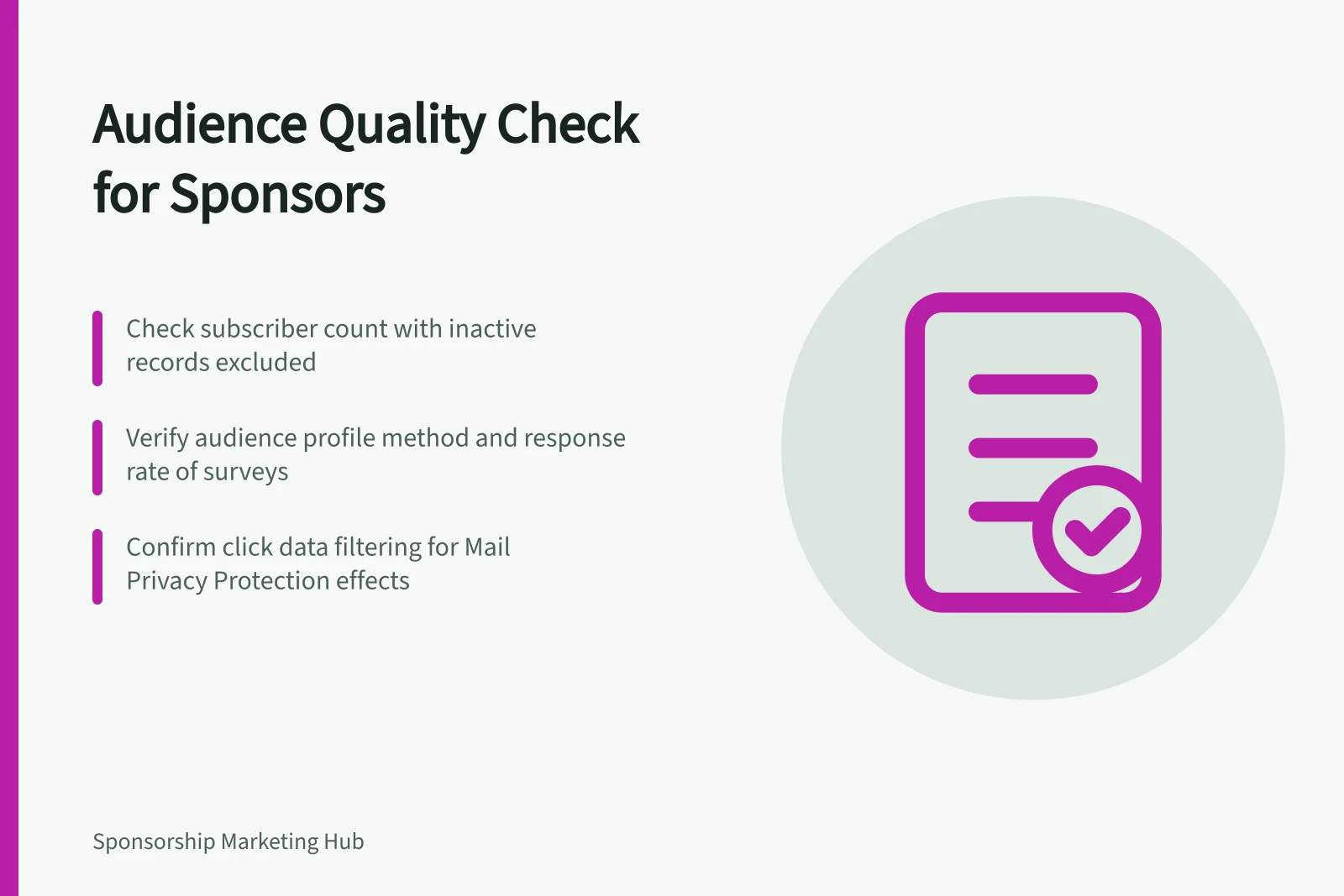
- Subscriber count for the named newsletter, dated and defined to show whether inactive or unsubscribed records are excluded.
- Sent and reported delivered counts for comparable issues, with the publisher’s definitions.
- Sponsor-position link interactions where available, including the filtering method and whether that link appeared elsewhere.
- An audience profile showing how geography, role or interest was established and what share of the audience it covers.
- Recent issues and examples of the proposed position, so the sponsor can judge the editorial context.
A voluntary survey describes its respondents. Ask for its response count and selection method before treating it as representative of the whole list.
A website-wide monthly audience is not the denominator for one email placement. Keep estimates separate from observed counts.
Key steps to evaluate a publication's audience quality before sponsoring
- Subscriber count for the named newsletter
- Sent and delivered counts for comparable issues
- Sponsor-position link interactions
- Audience profile with geography, role or interest breakdown
- Recent examples of proposed placement
Read the measurement limits
An open count is weak evidence that a person read an issue. Apple’s Mail Privacy Protection can download remote content without engagement.
Automated security services and link previews can also create recorded interactions. Ask whether the publisher filters these and whether the same method was used across the figures shown.
Clicks are an action signal, but they do not establish that a visitor is a qualified buyer.
Check list health through aggregate trends, not personal subscriber records. Ask how bounces and unsubscribes are defined and whether a sudden increase followed a new acquisition route.
A change needs an explanation; by itself it does not prove poor quality. If the publisher cannot provide a requested split, mark it unknown.
Critical metrics to verify before sponsorship
- Open rate (cautionApple Mail Privacy Protection may inflate)
- Click-through rate (not proof of buyer intent)
- Bounce and unsubscribe rates
Decide from the available evidence
Compare candidates on relevant audience, evidence quality, placement context, available reporting and a practical response path. Mark each claim documented, estimated or unknown.
A well-matched audience with modest but credible evidence may justify a small test; a broad claim with no method may call for a narrower proposal.
Agree before purchase what will be reported after the placement, using the same definitions where possible. This makes the pre-sale claim and delivered asset easier to compare.
Audience quality indicators: what to compare across publishers
- Audience fit with brand target
- Evidence quality
- Placement context
- Reporting transparency