
Rights Agreements
Part of Content and newsletter sponsorship
Comparing issue sponsorship with a long-term media partnership
Compare a single newsletter issue with a longer media partnership by commitment, deliverables, production work and review points.
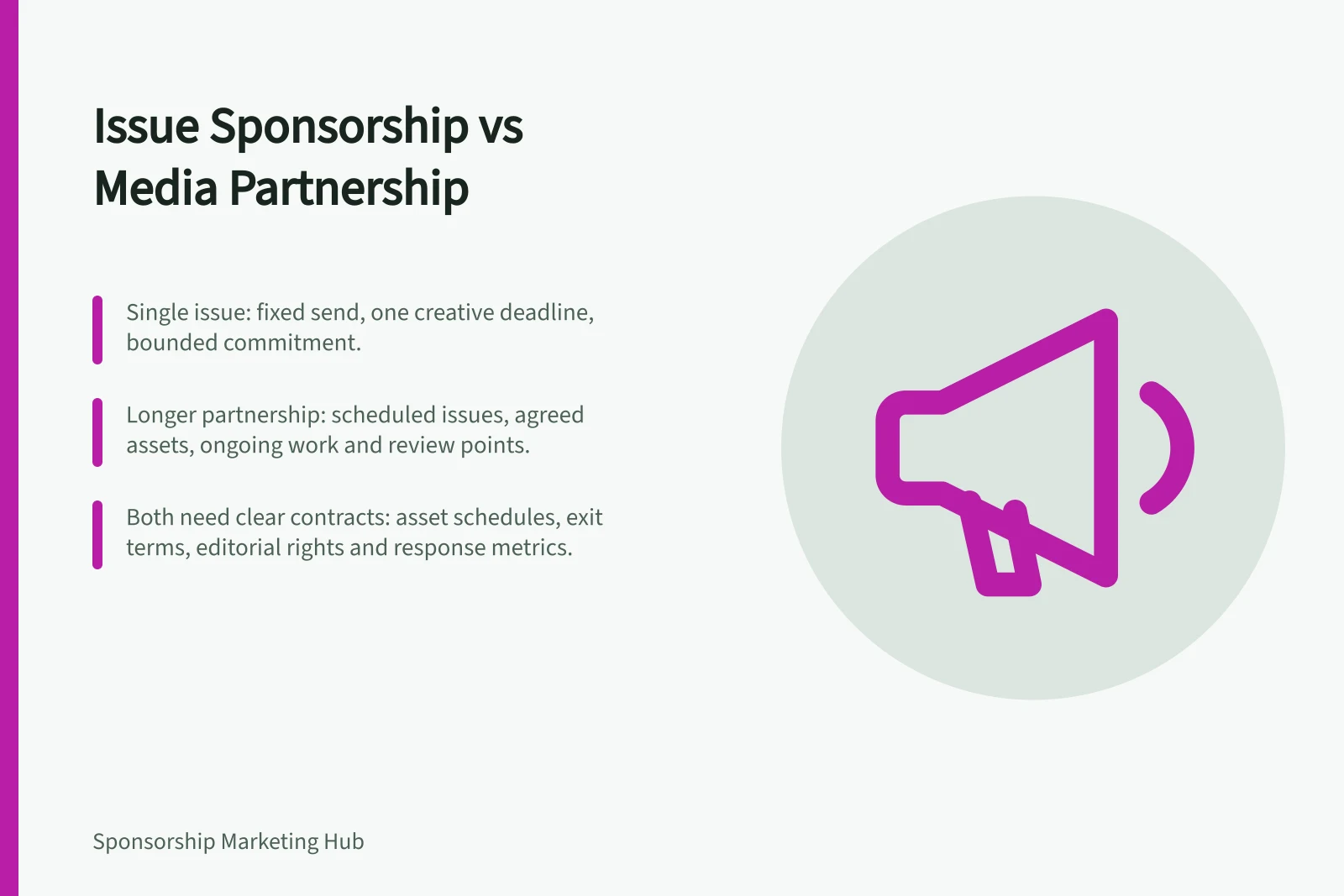
Pick an issue sponsorship for one defined send and a bounded commitment. A longer media partnership suits repeated placements or additional formats when they have a clear purpose and both sides can deliver the work. Compare the assets and obligations in the offer; neither package name promises a result.
Compare the commitments
| Question | Single issue | Longer partnership |
|---|---|---|
| What is fixed? | One issue, placement and creative deadline. | A schedule of issues and any additional agreed assets. |
| What can be learned? | An early signal about audience, message and response. | How agreed messages or formats perform across the schedule. |
| Main delivery risk | A missed send or poorly matched issue. | Unclear ownership, inconsistent placements or a schedule that outlives the offer. |
| Contract detail to settle | Issue, position, proof, send window and remedy. | Asset schedule, owners, review points, changes and exit terms. |
These are planning distinctions. Ask for sample issues and a written schedule.
A “partnership” might mean recurring sponsor credit or include commercial articles, events and permission to use the publisher’s name. List and price each component separately.
Test the reason for repeating
Map each proposed issue to a reader question or campaign purpose. Repeating identical copy to an overlapping list does not by itself reach a new audience.
Ask whether creative can change, whether competing sponsor positions are restricted and whether each issue can be reported separately. Treat audience growth estimates as forecasts and ask how they were made.
For an exploratory buy, a single issue with a review date may provide enough evidence for the next decision. Examine relevant visits, enquiries or another action chosen beforehand.
A weak response could reflect the message, landing page, audience or timing; one send rarely isolates the cause.
Account for the work
Put production, approvals, landing pages and staff time beside the quoted fee. A continuing partnership needs someone to supply material and manage deadlines.
Confirm whether unused placements expire, dates can move, rework costs extra and the publisher can change the format. These terms depend on the deal.
Keep editorial rights explicit. A longer commitment does not grant favourable editorial coverage.
If publisher staff create commercial content, agree on the reader-facing description and review of the sponsor’s claims. If the publisher independently edits a series, leave editorial decisions with its editor and make the sponsor credit clear.
Make the choice
Choose the issue when there is one timely message and the brand wants a bounded commitment. Choose the partnership when the additional schedule or assets have a specific use and the work is realistic.
For either choice, record what must run, what response would be useful and what remains uncertain. Use that record at renewal.

