
Sponsorship Valuation
Content and newsletter sponsorship
Choose content and newsletter sponsorship by checking the placement, audience evidence, editorial boundaries and useful measures.
Content and newsletter sponsorship gives a brand an agreed presence beside or within a publisher’s work. Start with the job the placement must do: carry a message in one newsletter issue, support a content series, or build a continuing relationship across several assets.
Then check the audience, rights and reporting for the assets offered. A subscriber total alone cannot show whether the right people will encounter the sponsor.
Choose the kind of presence
An issue sponsorship usually specifies a send, position and creative format. A longer media partnership may combine issues, website placements, events or commercial content. List each asset separately; the partnership label does not explain what is included.
Ask whether each proposed item is an advertisement, independently edited work supported by a sponsor, or publisher-created commercial content. That distinction affects who chooses the topic, writes the copy and approves changes. Agree on the description readers will see in the email and on any archived page.
| Decision | Ask for |
|---|---|
| Where will the sponsor appear? | The named issue or page, position, format and expected date. |
| Who controls the words? | Separate rules for the sponsor’s advertising claims and the publisher’s editorial decisions. |
| What if plans change? | An agreed replacement or remedy and the process for approving it. |
| What will be reported? | Delivery evidence and defined measures for each asset. |
Key Questions to Ask Before Signing a Newsletter Sponsorship
- Where will the sponsor appear?Confirmed issue, page, position, format and expected send date.
- Who controls the words?Separate rules for advertising claims and editorial decisions must be defined.
- What if plans change?Agreed replacement or remedy process with approval rights.
- What will be reported?Delivery evidence and defined metrics for each asset.
Check the audience behind the offer
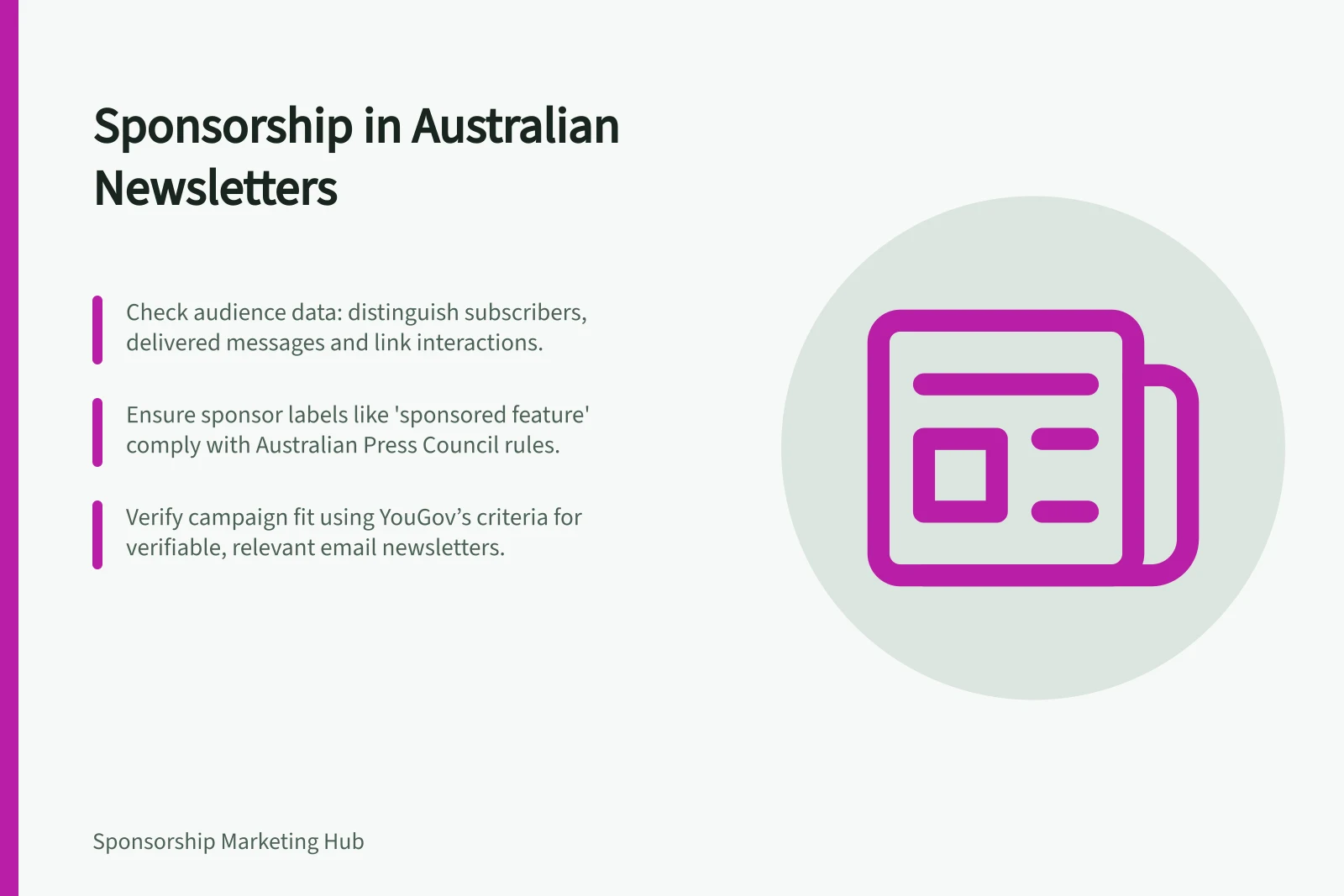
Request recent figures for the newsletter or content section being sold. For email, distinguish subscribers, messages sent, messages reported as delivered and interactions with the sponsor’s link. Ask for the reporting period, exclusions, geography and method behind any claimed professional or interest segment. A site-wide audience figure is background context for a specialist newsletter placement.
Read a few recent issues. Are their topics and reading level relevant to people the brand can serve? Is the proposed sponsor position clear? If the publisher cannot substantiate a claimed audience segment, treat it as an assumption in the buying decision.
Audience Metrics to Verify Before Sponsorship
- Subscribers
- Total number of subscribers to the newsletter.
- Messages Sent
- Number of emails delivered during the reporting period.
- Deliveries Reported
- Number of messages successfully delivered to recipient inboxes.
- Link Interactions
- Clicks on sponsor’s link; excludes automated activity.
Check campaign fit before selecting a newsletter
YouGov recommends using verified email newsletter campaigns and notes that not all newsletters offer good leads or return on investment. Treat those as selection criteria: check that the campaign is verifiable and that its audience and subject matter fit the people the sponsor wants to reach.
For the sponsor’s message, YouGov recommends a clear headline, descriptor and call-to-action button.
Protect the reader relationship
If the publisher retains editorial control, do not promise a favourable article, product mention or headline. For promotional copy, define who checks the brand’s claims and who can correct or reject the material. Put these boundaries in the production brief as well as the agreement.
Editorial Control vs. Sponsor Influence in Newsletter Sponsorship
- Editorial Control (Publisher)Determines topic, writing style, tone and final approval of content; ensures independence from commercial interests.
- Sponsor Influence (Brand)Can provide claims, messaging direction and creative input only within agreed boundaries; cannot dictate editorial outcomes.
Check how commercial content is labelled
The Australian Press Council lists terms such as “advertisement”, “advertising feature”, “special feature” and “sponsored feature” as ways to identify advertorials. It regards advertorials as advertisements, which are covered by the rules and guidelines that apply to advertising.
If a complaint concerns an advertorial, the Press Council usually redirects it to a relevant advertising or trade practices authority.
Check publication-specific limits
The ABC’s policy applies to its print magazines and associated digital versions, where advertising and sponsorship are permitted.
It defines sponsorship as a contribution to financing content or content services. The contribution is made by a person or organisation not engaged in producing the content or providing the content services. It is made with a view to promoting the sponsor’s name, trade mark, image, activities or products.
That policy says the ABC does not accept sponsorship for news content or content designed for preschool children. It also requires ABC editorial control and says editorial decisions must not be improperly influenced by commercial interests; these are ABC rules, not universal terms for other publishers.
Plan a response readers can choose
Give interested readers a relevant next step, such as a guide, product explanation or enquiry page. Use a distinct destination or campaign identifier for each placement if the sponsor can measure visits.
Ask whether the publisher can report link interactions for the sponsor’s position and how it handles automated activity. Opens are a weak proxy for reading: Apple’s Mail Privacy Protection can download remote email content without the recipient engaging with the message.
Sponsorship does not itself include access to the publisher’s subscriber list. If either party proposes transferring contact details or sending later marketing, check the proposed collection, disclosure and contact path against applicable Australian privacy and spam requirements. The rules depend on the parties and the intended messages.
Review delivery before results
First confirm what ran: date, position, copy, commercial description and destination. Then assess the defined interactions and any voluntary response. A visit, enquiry or sale may have other influences, so describe it as an observed outcome unless the measurement design supports a stronger conclusion.
Use that evidence to decide whether to repeat the issue format, change the message, seek a better-matched audience or consider a broader partnership. Record which part of the package informed the decision.
In this guide
- Comparing issue sponsorship with a long-term media partnershipCompare a single newsletter issue with a longer media partnership by commitment, deliverables, production work and review points.
- Evaluating a publication's audience quality before sponsoringAssess a publication’s audience using placement-specific reach, fit, source methods and measurement limits before agreeing to sponsor.
- Agreeing on editorial independence in a content sponsorshipSet clear control of topics, claims, approvals, corrections and sponsor descriptions in a content sponsorship agreement.
- Measuring newsletter sponsorship beyond total subscribersMeasure newsletter sponsorship using delivery, defined clicks, site visits and useful responses while accounting for open and bot limits.


![Clear sponsorship purpose for brands: Define the change wanted in a group over time, with a business reason.; Use: 'We want [audience] to [action] because [reason]' with owner and budget.; Check if sponsorship fits: rights, audience access, and partner’s capacity. Defining the business purpose of a sponsorship](/covers/defining-the-business-purpose-of-a-sponsorship-640.webp?v=7217a710)