
Sponsorship Valuation
Sponsorship research and audience evidence
Check audience figures against specific sponsorship rights, assess their sources and methods, and record what remains unknown.
Start with the sponsorship right you are assessing, then find evidence about the people who could encounter it. Check what each figure counts, how it was produced and whether it covers the proposed activity. A property-wide audience figure provides context; it does not show who saw a particular sponsor asset.
Define the evidence question
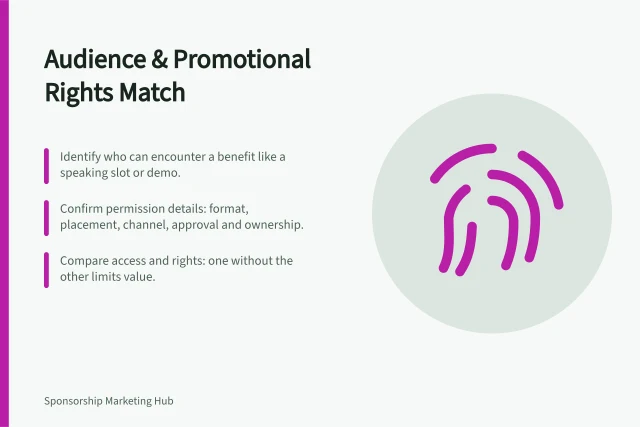
Name the right: an on-site activity, an organiser post, a programme credit or another specified benefit. Describe who would have to attend, receive or view something to encounter it. A workshop audience may be more relevant to a workshop sponsor than attendance at the whole event.
Write down the decision the evidence must support. This keeps the research focused on a useful audience question rather than the largest number in a proposal.
Sponsorship Right Relevance: Audience Figures Compared
- Event AttendanceContextual scale; does not confirm attention to sponsor asset
- Newsletter AudienceSubscriber list or sends; does not confirm reading of sponsor placement
- Social AudienceAccount metrics or content reach; does not confirm attention to one sponsored post
- Audience ProfileAttributes of a subset; does not apply to all audience members
Keep a trail for each claim
For each material figure, retain the original report or extract. Record its owner, date, reporting period, population, unit and method. Mark it as an observed count, survey estimate or forecast. Where sources are combined, ask how overlap was handled.
| Figure supplied | Definition to check | What it cannot establish alone |
|---|---|---|
| Event attendance | Entries, tickets, registrations or people present; dates and repeat visits | Attention to a sponsor sign or activity |
| Newsletter audience | Named list and issue; subscribers, sends or another unit | Reading a sponsor placement |
| Social audience | Account, content, metric and reporting period | Attention to one sponsored post |
| Audience profile | Source of attributes and share of the audience covered | Attributes of people with missing details |
Do not add these figures into one unique reach total. Their units and periods may differ, and the same person may appear in several. For a digital ‘unique audience’, check whether the unit is people, devices or another identifier and how duplication was addressed.
Test whether the method supports the claim
A ticketing record can answer a ticketing question. It may not count everyone present or anyone who noticed a sponsor. A voluntary survey describes its respondents; extending its answers to all attendees needs a sampling method that supports that inference. Check eligibility, recruitment, completed responses and groups that may have been missed.
Use evidence from comparable activity where possible. Last year’s whole festival, another venue and an unusually prominent post can provide context, but none is a direct forecast for a proposed placement. Note changes in programme, channel and measurement method beside any comparison.
Use a fit-for-purpose quality check
The Australian Bureau of Statistics (ABS) Data Quality Framework assesses data quality in relation to a user’s purpose. It identifies seven dimensions: institutional environment, relevance, timeliness, accuracy, coherence, interpretability and accessibility. A source need not score equally on every dimension for every decision; judge which matter most to the sponsorship right being considered.
For example, relevance matters when the dataset’s population or measures may not match the proposed audience. Coherence deserves more attention when comparing figures across periods or sources. If credibility and trustworthiness are central, scrutinise the institutional environment of the data.
A concise quality statement can make this assessment usable. The ABS recommends communicating key characteristics that affect quality, including both strengths and limitations, so readers can decide whether the data are fit for their purpose.
ABS Data Quality Framework: Seven Dimensions for Sponsorship Evidence
- Institutional Environment
- Trustworthiness of the data provider
- Relevance
- Fit of population and measures to sponsorship right
- Timeliness
- Currency of the data relative to decision timing
- Accuracy
- Closeness to the true value
- Coherence
- Consistency across sources and time
- Interpretability
- Clarity of definitions and context
- Accessibility
- Ease of access and usability of the data
Separate sampling error from other error
A survey estimate based on a sample can differ from the value that a complete count of the population would produce. The ABS calls this sampling error.
Sampling error can arise when a sample is too small, differs in its characteristics from the population, or is selected using a method that is not random. In a random sample, where each unit has a calculable chance of selection, sampling error can be measured and controlled; increasing sample size generally reduces it.
A larger sample does not resolve every weakness. Non-sampling error can arise at any stage and includes coverage error, when people are wrongly included, excluded or duplicated; non-response error, when selected people provide no or only partial information; and response error, when answers are inaccurate.
For a sponsorship audience claim, ask whether the people who could encounter the specified right were covered and whether missing responses might affect the result. Record these limitations separately from the estimate itself: they affect how confidently the result represents the intended population.
Sampling Error vs. Non-Sampling Error in Sponsorship Research
- Pros of Sampling ErrorCan be measured and controlled with random sampling; reduced by increasing sample size
- Cons of Sampling ErrorOccurs if sample is too small, unrepresentative or non-randomly selected
- Pros of Addressing Non-Sampling ErrorImproves validity when coverage, response and non-response errors are minimised
- Cons of Non-Sampling ErrorIncludes coverage error (wrong inclusion/exclusion), non-response error, and response error
Check the digital measurement context
Digital audience figures can depend on the measurement method as well as the metric. In April 2021, IAB Australia said it could not support tagged monthly audience data in Nielsen’s soft-launched Digital Media Ratings while methodology concerns and data queries remained unresolved. Its review raised concerns about variation in unique-audience results after a methodology change.
The IAB distinguished that audience measurement from volumetric data measured through media-owner tagging, such as page views, time spent and sessions. It continued to support market use of that overnight traffic data, while noting that the methodology for untagged sites had not changed.
Use this example as a prompt to check the specific product, method and period behind a digital claim, rather than treating all metrics from a platform or publisher as interchangeable. A change in method can affect comparability even when a metric has the same name.
Digital Audience Measurement Methods: IAB Australia Guidance vs. Nielsen DMR
- Method
- IAB Australia's endorsed approach
- Metric Type
- Volumetric data (page views, time spent, sessions) via media-owner tagging
- Support Status
- Supported for market use
- Method
- Nielsen Digital Media Ratings (untagged sites)
- Metric Type
- Tagged monthly audience data (unique users)
- Support Status
- Not supported due to unresolved methodology concerns
Make quality limits actionable
State what the evidence supports and what remains outside its reach. A dataset may be accurate for its recorded population yet not relevant to a particular right; a credible source may still have limited coverage or timeliness. The ABS framework treats quality as fitness for purpose, so the same dataset can warrant different judgements for different decisions.
Keep the limitation attached to the claim when it is shared. If a profile omits some audience members, describe the measured group rather than implying the attributes apply to everyone. If methods or definitions differ between periods, identify the break before presenting a comparison.
Record the decision and its limits
Ask what the property can report for the specific right before buying it. After delivery, keep three questions separate: did the asset run, who might have encountered it, and what response was measured? If the reporting method changed, state that before comparing periods.
A brief evidence note can label each material claim supported, supported with narrower wording or unknown, then say how the gap affects the decision. Verified event attendance, for example, may support the event’s scale while leaving a workshop audience unknown. The buyer can request workshop evidence, narrow the right or proceed with that uncertainty recorded.
In this guide
- Evaluating a sponsor deck's audience claims before purchaseCheck the source, denominator and relevance of audience figures in a sponsorship deck before using them to assess a proposed right.
- Designing a survey about sponsor recognitionDefine the population, write neutral unaided and prompted recognition questions, plan recruitment and report findings within their limits.
- Comparing attendees with the wider media audienceCompare on-site and media audiences by population, period, geography and sponsor asset without adding overlapping figures into false reach.
- Recording limitations in a sponsorship impact studyDocument sampling, missing data, method changes and competing influences next to the findings they limit.