Community Sponsorship
Part of Community and local sponsorship
Choosing a local property that matches the service area
Compare a local group’s real catchment with where your business can serve people, without relying on venue address or inflated totals.
Choose a local sponsorship opportunity by matching where its people come from with where the business can serve them. A venue address is a weak test. Define the service area first, then ask the organiser what it knows about participants and supporters.
Draw the business boundary
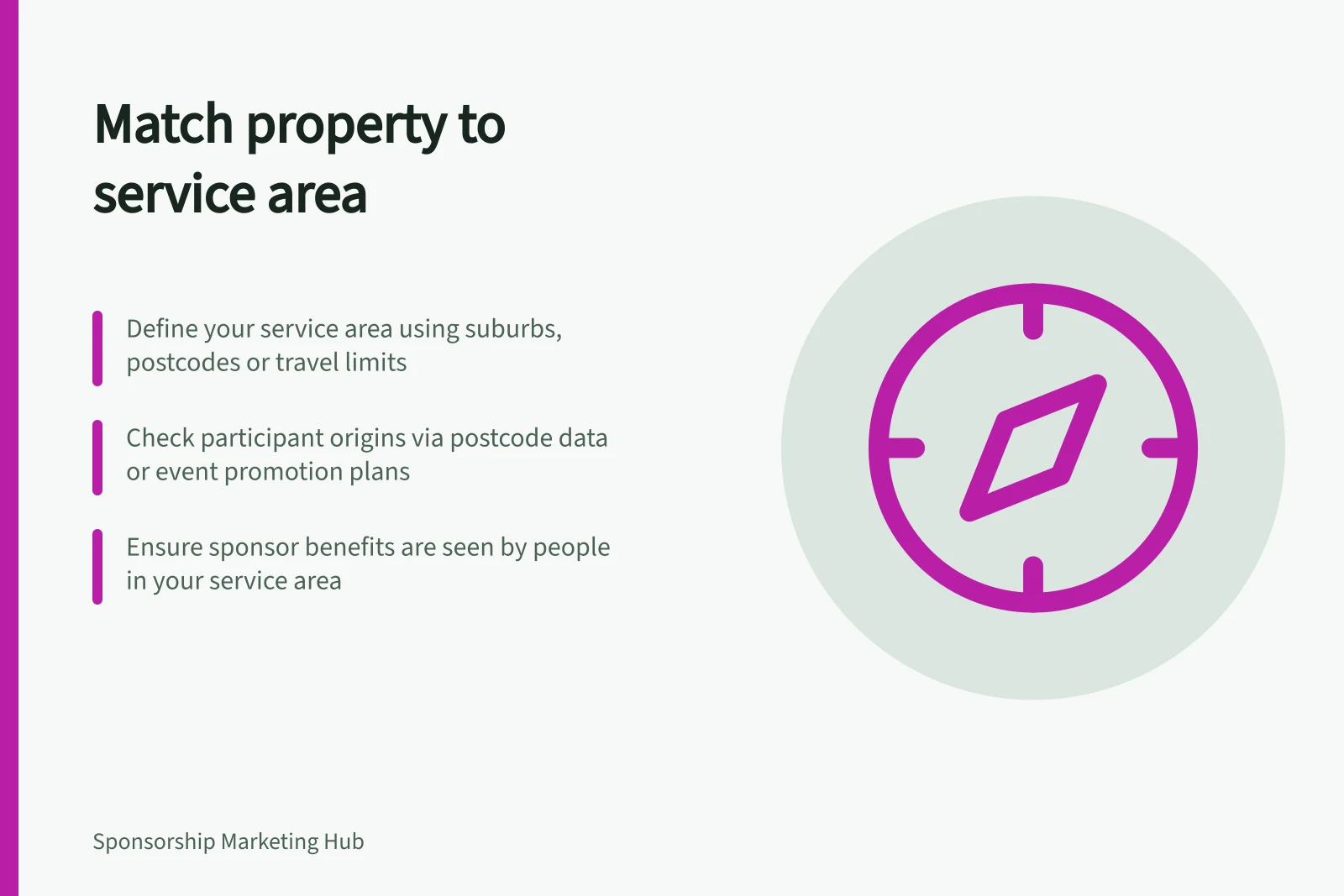
List the suburbs, postcodes or travel limits where an enquiry could become a useful customer relationship. Include practical exceptions: a mobile service may stop at a difficult crossing, while a shop may draw customers from nearby workplaces as well as homes. If service is available only on certain days, record that too.
Decide whom the business wants to reach in that area. Residents, visiting families, local employers and volunteers are different groups. Supporting an activity may still be worthwhile when few participants are prospective customers, but treat that as a community decision, not an assumed marketing result.
Key Considerations When Matching Sponsorship with Service Area
- Service Area DefinitionSuburbs, postcodes, or travel limits where enquiries can become customers
- Practical ExceptionsMobile services may stop at difficult crossings; shops serve nearby workplaces
- Target Audience TypesResidents, visiting families, local employers, volunteers – each requires different outreach
- Community Support vs. Marketing FitSupporting an event may still be valuable even if few attendees are potential customers
Ask where the activity’s people are
Request recent information the organiser already holds: aggregated participant postcodes, prior attendee origins if collected, printed-material distribution areas, or locations of regular activities. Ask which figures come from records and which are estimates. A summary is usually more useful here than individual contact details.
For a new event without attendance history, review its programme, venue access, promotion plan and community connections. These are clues, not a promised catchment. An event in one suburb may draw people from several towns; a smaller recurring group may overlap more closely with the business’s service area.
Compare candidates consistently
| Question | What to check |
|---|---|
| Where do participants and supporters usually come from? | Geographic overlap and the quality of the evidence. |
| Where will the sponsor benefit appear? | Whether people in the service area are likely to encounter it. |
| What could an interested person do next? | Whether the business can serve the resulting enquiry. |
| What work does delivery require? | Whether both sides can fulfil the arrangement. |
Do not combine membership, attendance and social followers into one ‘local audience’ number. The groups may overlap, cover different periods or include people well outside the service area. If the organiser has only a broad total, ask for a narrower description or decide without an audience-size claim.
Evaluating Sponsorship Opportunities Against Service Area Criteria
- Where do participants and supporters usually come from?Geographic overlap with service area; quality of evidence (e.g., postcode data vs. estimates)
- Where will the sponsor benefit appear?Likelihood that people in the service area will encounter the sponsorship visibility
- What could an interested person do next?Whether the business can respond to enquiries from the local catchment
- What work does delivery require?Feasibility for both sponsor and organiser to meet commitments
Make the choice explicit
A useful marketing fit has plausible geographic overlap, a benefit people there could encounter, and a response path the business can fulfil. A weaker marketing fit may still merit support when the community outcome is the primary aim. Record that purpose separately so later reporting does not imply the activity was designed to deliver local sales.
If the organiser is a registered charity, its charitable purpose, resources and partnership risks also matter. If either party cannot explain why the proposed relationship helps, narrow it or consider another activity.
Steps to Choose a Local Sponsorship That Matches Your Service Area
- Define your business boundary using suburbs, postcodes or travel limitsInclude practical exceptions such as mobile services or workplace-based customers
- Identify who you want to reach within that area: residents, employers, volunteers, etc.Recognise that community support may be valid even if not directly tied to customer acquisition
- Request real data from the organiser: participant postcodes, distribution areas, activity locationsAsk whether figures are based on records or estimates; avoid inflated totals
- For new events, assess programme, access, promotion and community linksUse these as indicators of likely catchment—don’t assume a single suburb is the full source
- Make the decision explicit: record purpose and fit levelDistinguish marketing goals from community outcomes; note if partnership lacks clear rationale