Rights Agreements
Sponsorship brand risk
A practical framework for checking a sponsorship partner, agreeing on brand controls, responding to incidents and reassessing the association.
Manage sponsorship brand risk across the relationship: check the proposed partner, define the public association and usable rights, prepare for incidents, and review when circumstances change. A good reputation today cannot guarantee future conduct or audience reaction.
Identify the association at risk
A sponsorship can place a brand beside an organisation, event or person in public material. Risk depends on what people actually see. Credit for one event differs from a season-long naming role or a campaign using a person’s image.
Ask who the brand will be associated with, how each party may describe the relationship, who controls the material, and what would make the association unsuitable. Check the contracting party plus any people or organisations central to delivery. An organiser’s failure to supervise an activity or correct an inaccurate sponsor description can matter even without a public controversy.
Check before agreeing
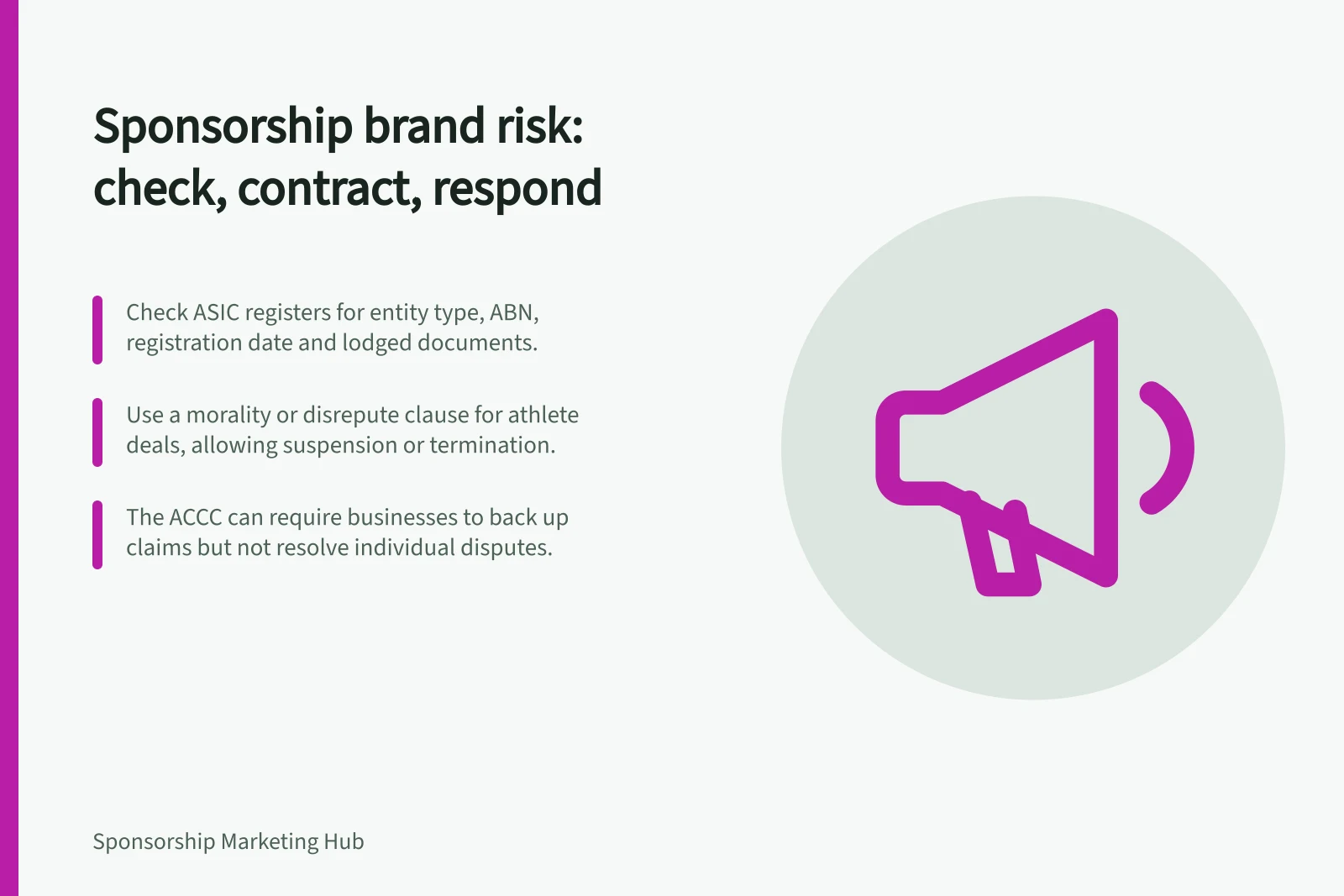
Match the depth of the check to the deal’s visibility, duration and proposed activity. ASIC’s company and organisation registers can confirm basic details for Australian companies and certain other entities.
A register entry does not establish trustworthiness or delivery capacity. If a property says it is a registered charity, consult the ACNC Charity Register for information published about the charity.
ASIC’s registers cover Australian companies, registered Australian bodies, foreign companies operating in Australia and managed investment schemes. Free information can include entity type, ABN or other identifier, registration date, next review date, registered-office location and a list of documents lodged with ASIC.
For an ongoing relationship with an Australian company, ASIC’s company alert service can help track changes made to that company. Treat a register change as a prompt to consider whether the association or delivery arrangements need attention, not as proof of misconduct.
Where an essential question remains open, narrow or defer the proposed use. The detailed method for checking a partner’s reputation before a deal is set out in a companion article.
Agree on workable controls
Specify how each party may describe the relationship and use the other’s name or assets. Record channels, dates, approvals and the contact for correcting live material. Claims such as ‘official’ or ‘exclusive’ should reflect the actual arrangement.
Agree who reports a material incident, who can pause scheduled joint activity and who can accept a change. Put any intended pause, review or exit process in the agreement. An internal risk plan does not itself change contractual rights.
If a sponsor makes a claim about its own products or services in joint material, it should be able to support that claim. The ACCC can require businesses to back up claims and may investigate possible misleading claims, but it does not resolve individual disputes or provide legal advice.
Make contractual responses proportionate
For athlete sponsorships, consider whether the agreement needs a morality or disrepute clause for conduct that could affect the association. Such clauses can be drafted broadly or narrowly, and may allow suspension or termination if specified behaviour occurs.
Define the conduct covered and the response available rather than relying on a general expectation of suitable behaviour. The wording should fit the sponsor’s values and the athlete’s circumstances; clauses that are too restrictive can cause negotiations to fall through.
A clause is a possible contractual tool, not a substitute for assessing an incident when it arises. Record who can exercise any agreed right and how it relates to other pause, review or exit processes in the agreement.
Prepare and respond
Settle in advance who will raise a concern, who decides and who communicates, and keep any response tied to the agreement and the particular association at risk. If an incident occurs, address immediate harm to people through the appropriate operational process while the facts are established, rather than treating a disputed claim as a finding.
A companion article sets out the step-by-step incident escalation plan.
Incident response sequence
- Settle roles in advanceDecide who raises a concern, who decides and who communicates.
- Address immediate harmUse the appropriate operational process while the facts are established.
- Tie response to the agreementKeep any response tied to the agreement and the particular association at risk.
- Do not treat a disputed claim as a findingEstablish the facts before acting on an allegation.
Reassess as facts change
Review the connection between the issue and the contracted property, the brand assets still visible, the agreement and the partnership’s purpose. Options may include continuing with controls, narrowing or pausing particular activity, agreeing on a change, or seeking an end under the agreement. Record the reasons, authority, remaining uncertainty and next review point.
Revisit the decision when material evidence arrives and during ordinary partnership reviews. A decision to pause promotion records the sponsor’s action; it does not prove an allegation.
Note which material remains public and which contractual options are being considered; changing one use of a name or image may address a different exposure from pausing all joint activity.
Reassessment prompts
- Review the connectionCheck the link between the issue and the contracted property, the brand assets still visible, the agreement and the partnership’s purpose.
- Consider proportionate optionsContinue with controls, narrow or pause particular activity, agree a change, or seek an end under the agreement.
- Record the decisionRecord reasons, authority, remaining uncertainty and the next review point.
- Revisit when evidence arrivesReassess when material evidence arrives and during ordinary partnership reviews.
- Distinguish action from proofA decision to pause promotion records the sponsor’s action; it does not prove an allegation.
In this guide
- Checking a sponsored property's reputation before a dealVerify the proposed partner, assess relevant reputation concerns and record a clear pre-deal sponsorship decision.
- Writing an escalation plan for a sponsorship incidentSet triggers, contacts, decision authority, first actions and message approvals for a sponsorship incident.
- Reviewing a sponsor association after a public controversyAssess the facts, live brand association and agreement before deciding whether to continue, pause, change or end a sponsorship.
- Separating documented facts from speculation in a risk reviewClassify records, allegations, interpretations and unknowns so sponsorship risk decisions use evidence without overstating it.