Rights Agreements
Part of Sponsorship brand risk
Checking a sponsored property's reputation before a deal
Verify the proposed partner, assess relevant reputation concerns and record a clear pre-deal sponsorship decision.
Check the specific organisation, event or person the brand would publicly support. Match the proposed property, rights seller and signing party, then scale the record checks to the association’s length, prominence and complexity. Record one outcome: proceed, proceed with conditions or decline, and state the evidence and unresolved questions behind it.
Establish who and what is being checked
Identify the party named in the proposal and the party that would sign. Ask who controls the activity and public assets on offer. An event's reputation does not answer questions about its organiser, a rights seller or a third party responsible for delivery.
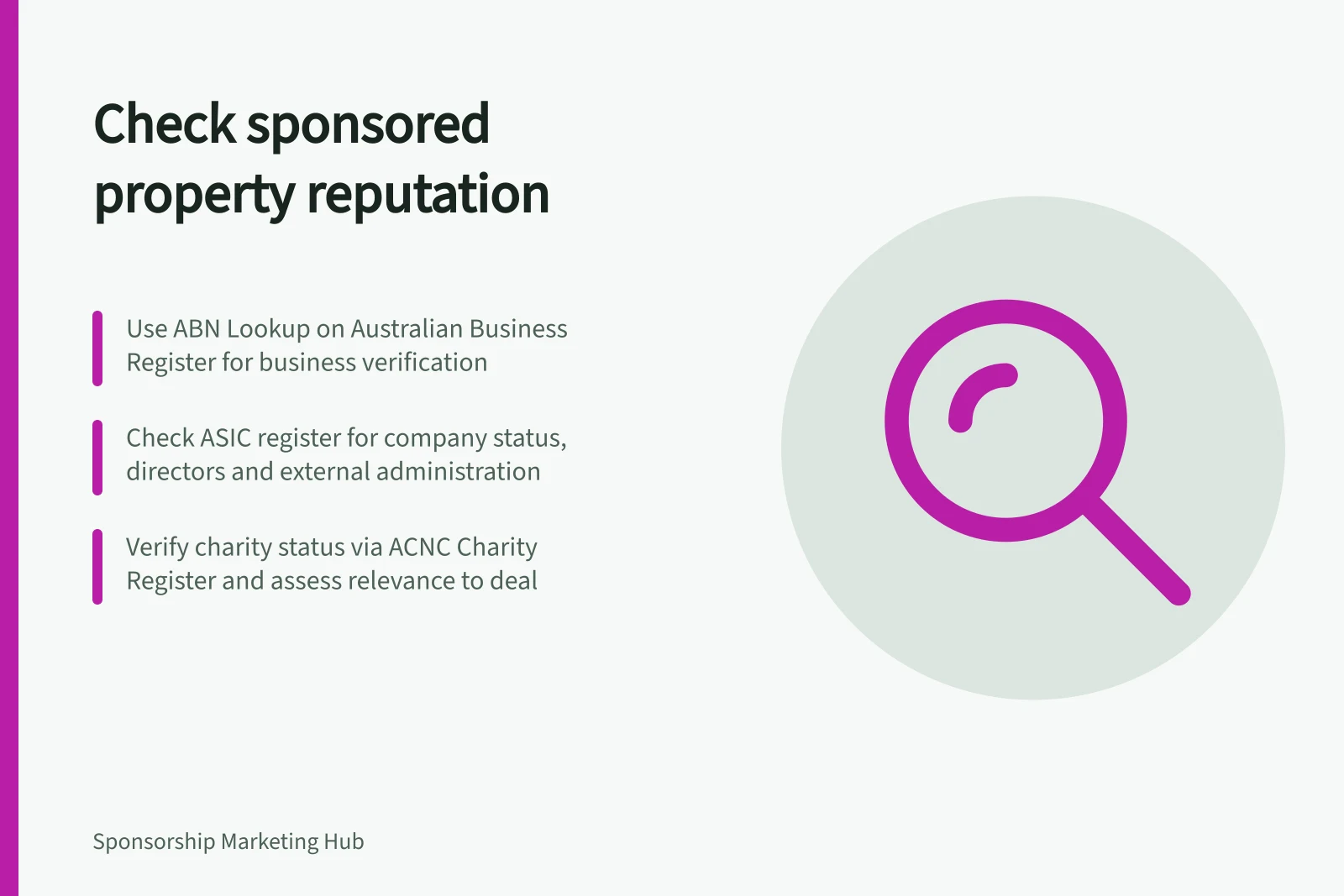
For a business, start with ABN Lookup on the Australian Business Register. Search by name, ABN or ACN, then compare the result with the proposal: ABN Lookup shows whether an ABN is active or cancelled, the business type and GST status, public details and historical trading names where available.
For a company or other organisation covered by ASIC, search its company and organisation registers by organisation name, registered business name or a unique identifier such as an ACN. The free information includes the entity type, ABN, ACN, ARBN or ARSN, registration date and documents lodged with ASIC.
If the property presents itself as a registered charity, check the ACNC Charity Register. A register listing is not an endorsement of a proposed deal.
Make identity checks the baseline for every proposal. For a one-day placement, focus further checks on the organiser and any party controlling a right used in the placement; for a long naming relationship, check each material rights-holder and recheck if time passes before commitment.
Key Regulatory Resources for Due Diligence
- ASIC Company Register
- Free access to ABN, ACN, ARBN, registration date and documents
- ACNC Charity Register
- Confirms registered charity status (not endorsement)
- ACCC False Claims Guidance
- Businesses must substantiate public claims; may face investigations
Search for concerns relevant to the deal
For a company, check the ASIC companies register for its registration status and whether it is under external administration, which ASIC identifies as a warning sign. A paid company extract can show current directors and how long they have been directors; compare those details with the people presented as responsible for the deal.
Where a named person is relevant, check ASIC’s Banned and disqualified register. Review ASIC’s Enforcement activities information for published material relevant to the property or the people involved; a register entry or enforcement item is a lead to assess, not a decision by itself.
Review the property's recent material and credible records concerning the proposed activity. A formal finding, documented change in control or repeated delivery problem may warrant a question. Check whether a key venue, participant or media right depends on someone else.
Record who made each material claim, when, the evidence available and any response. A negative post is not automatically a finding. A report about an entity with a similar name requires an identity check, and an empty search result does not prove that no problem exists.
Put a precise question to the property when a concern could affect the brand's role. Request its current position and relevant documents, then record what remains unverified.
Test the proposed public association
Describe exactly how the brand would appear: a single acknowledgement, joint content, a person's appearance or a longer naming relationship. Ask whether each concern bears on that visible connection. The same issue may affect a one-day placement and a long campaign differently, but visibility alone does not decide suitability.
For each material finding, record five fields: finding, source and date, relevance to the proposed right, remaining uncertainty, and action needed. Give the decision-maker the original record where practicable, and distinguish verified facts from allegations or claims that remain unverified.
If the brand may repeat a factual claim in public, ask for evidence that supports it and check that the wording matches the rights agreed. The ACCC says it can require businesses to back up claims and may investigate misleading claims.
Make the decision explicit
Record proceed when the relevant parties and rights are identified and no material concern remains unresolved. Record proceed with conditions when a specific, manageable issue can be resolved before commitment, such as receiving a missing permission or changing the proposed public wording.
If a material answer is still outstanding, do not record an unconditional proceed. Set out the evidence or action required as a condition; decline if the identity cannot be established or a serious unresolved issue central to the association cannot be addressed.
Date the assessment and name who can change the decision. Set a recheck before a major announcement if time has passed or credible new information appears.