Rights Agreements
Negotiating sponsorship agreements
Negotiate sponsorship deliverables, fees, brand permissions and change terms in an agreement both parties can use.
Negotiate the agreement around promises both parties can deliver and check. Identify the sponsor's essential benefits, the support it will provide, who controls each right, the fee and the response if plans change. Discuss price against that defined package, rather than a tier name or a broad promise of exposure.
Agree on the negotiating brief
Each party should state what it needs from the arrangement and what it can realistically supply. Separate essential benefits from desirable ones. If an on-site activity is central to the sponsor's purpose, an extra logo placement is not necessarily a useful substitute.
Use the brief when trading terms. A lower fee may come with narrower rights; a wider placement may require more production work. Record each proposed concession alongside the obligation it changes. If a term remains unclear, resolve it before signing rather than expecting the teams to settle it during delivery.
Put the rights in a schedule
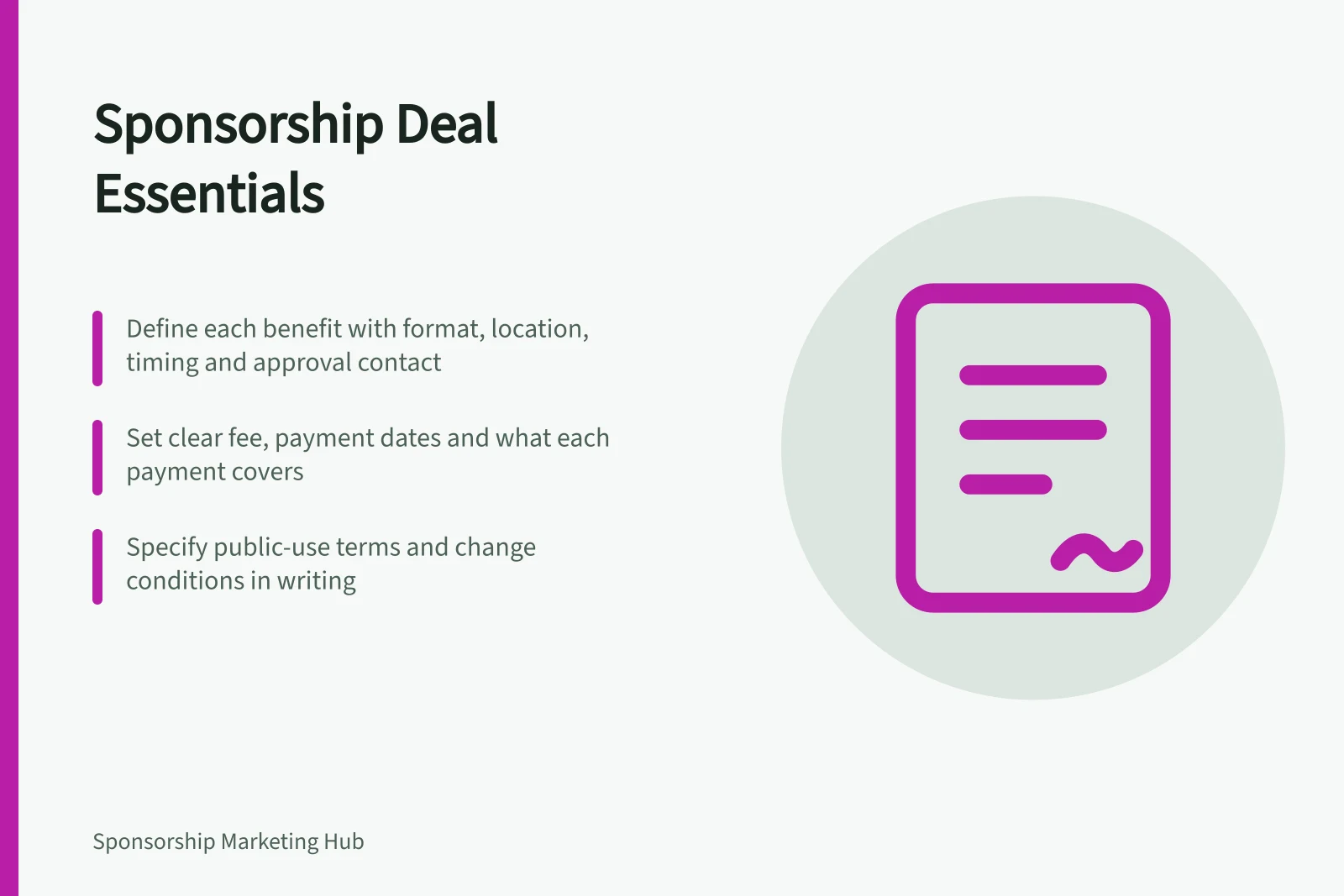
Name each benefit, its format, location or channel, timing, responsible party, approval contact and delivery record. Distinguish an acknowledgement the organiser publishes from material the sponsor supplies and from permission to use the organiser's name or mark in the sponsor's own channels. A label such as 'major partner' defines none of these on its own.
Check who controls every promised asset. A venue, publisher or participant may need to approve a use the organiser cannot grant alone. If permission is outstanding, record the condition, a decision date and what happens if it is refused. Mark which benefits may be replaced and which require the sponsor's express agreement to any change.
Define the permission being granted
Where a sponsor's use depends on a licence, distinguish permission to use an asset from ownership of it. IP Australia describes an exclusive licence as excluding the owner and others from commercialising the licensed IP, while a sole licence lets the owner continue to commercialise some aspects. Under a non-exclusive licence, more than one party can have permission to use the IP.
An exclusive licence can be limited to a particular geographical area, field of application or class of product. Define any such boundary when negotiating exclusivity, rather than leaving either party to infer its reach from a general label.
Types of IP Licences in Sponsorship Agreements
- Exclusive LicenceExcludes owner and others from commercialising the IP; may be limited by geography or product type
- Sole LicenceOwner retains right to use some aspects of the IP; only one other party has permission
- Non-Exclusive LicenceMultiple parties may use the IP simultaneously
Set the fee and the work behind it
State the fee, payment dates and what each payment covers. Mark production, installation, staffing, equipment, travel and reporting as included, separately paid or unresolved. Allocate the cost of requested changes. If delivery runs over a season, the parties can negotiate payments or review points around meaningful stages; that is a choice, not an automatic entitlement.
Agree on a response to a missed item while it may still be corrected. Depending on the agreement, the parties might use a revised deadline, an approved replacement or a payment adjustment. Do not leave the remedy to an assumption about the package's value.
Set public-use and change terms
Specify permitted names, logos and relationship descriptions, plus their channels, territory and period. Name the people who approve material and set workable response deadlines. Public claims should match the rights granted: exclusivity for one event should not be described as exclusivity across an entire organisation. The ACCC says it can require businesses to back up claims they make about their products or services.
Define the event changes that require a fresh decision, such as a new date or the loss of an essential activity. Agree who gives notice, how alternatives are accepted and how delivered benefits and committed costs will be assessed. Agree in writing what happens if an event is cancelled or changed, including any refund, credit or release from obligations.
ACCC Guidelines on Public Claims in Sponsorship
- Claim Accuracy Requirement
- Businesses must substantiate claims about products or services
- Exclusivity Limitation
- Exclusivity for one event does not imply exclusivity across an organisation
- Approval Process
- Public material must be approved by designated contacts within set deadlines
Resolve uncertainty before commitment
Before negotiations begin, learn about the other party's business, including what it does, who its customers are and where its strengths and weaknesses lie. Business.gov.au recommends preparing a clear view of what you want from the contract; that gives both parties a firmer basis for discussing terms.
Keep discussions respectful and calm, including when a term is disputed. Take notes of what was discussed and agreed so the draft reflects the conversation and later changes do not create confusion.
Commercial contract terms can be chosen within the limits of the law, but a court can set aside a contract that is harsh or unfair. Other laws may apply to a particular industry or profession, so identify relevant requirements before agreeing to a term. Once signed, contract terms are legally binding; do not sign expecting to resolve an unclear word or obligation later.
Check the final documents together
Before signing, compare the agreement and schedule for consistent parties, dates, fee, deliverables, permissions and change terms. Keep the agreed version and record later amendments in writing. Set a review point early enough to correct a missed placement or delayed approval.
At the end, compare the schedule with evidence of delivery. A programme copy or photograph can confirm a placement at a point in time. It cannot establish how many people noticed it or what business result followed. Keep those questions separate when deciding what to negotiate next time.
In this guide
- Defining exactly what a sponsorship package includesItemise each sponsorship benefit by format, owner, timing, approval, cost and delivery evidence before signing.
- Agreeing on approval rights and brand usageSet sponsorship brand permissions, proof approvals, accurate relationship wording and the end of each permitted use.
- Planning what happens when a sponsored event is cancelledPlan sponsor notice, benefit accounting, alternatives and payment decisions if a sponsored event is cancelled.