Activation Planning
Part of Sponsorship activation planning
Turning sponsorship rights into useful audience experiences
Design a useful audience activity, then check that the sponsorship right, setting and resources can support it.
Start with what people are trying to do when they encounter the sponsorship. Choose an activity that helps them, then check that an agreed right permits it.
A sign, post or space creates an opportunity. It does not explain why someone should participate.
Describe the useful moment
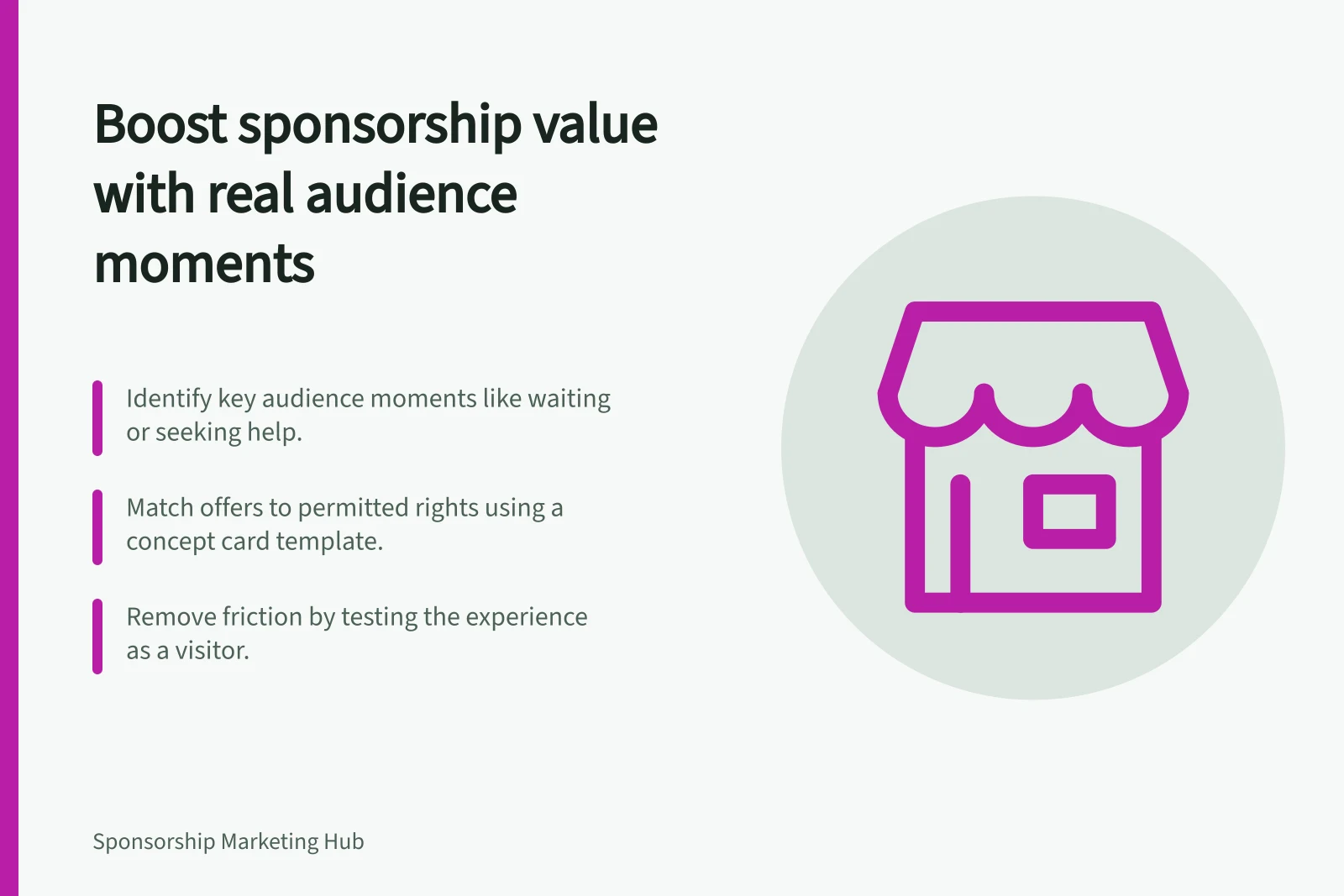
Ask whether people are arriving, waiting, reading a program or seeking practical help. Finish the sentence: “At this moment, people can usefully ___.”
If the answer is only “see our logo”, an acknowledgement may be enough. There is no need to present it as an interactive experience.
A short explanation, demonstration or tool can work when it suits the program and the brand can deliver it. Keep the invitation brief enough for the setting.
Someone passing between sessions may welcome information they can take away. They may have no time for a sales conversation.
Match the idea to a permitted use
Separate what the property will publish from what the sponsor may do. A program acknowledgement does not grant demonstration space. On-site participation does not automatically grant later use of the property's mark.
Treat permission as specific to the proposed use. Check the agreed terms, including any third-party asset.
Use a short concept card:
Field / Decision
- Audience moment
- Where and why someone may encounter the activity.
- Useful offer
- What the person can learn, try or obtain.
- Required right
- The specific space, channel, asset or participation permission.
- Practical limit
- Capacity, access, staffing, duration or approval.
- Optional next step
- What an interested person can choose to do afterwards.
Imagine a regional festival and a gardening retailer. If the package grants staffed space, a brief plant-care demonstration could be an option.
The parties would still need to confirm program fit, space, equipment, access and staff instructions. This is a design example, not a real campaign.
Remove friction
Walk through the idea as a visitor. Is the offer clear without a staff member stopping people? Can visitors with different access needs take part or get the useful information another way?
Consider routes, communication and participation needs during planning. Work with the organiser on the actual site rather than assuming the venue’s general setup covers the activity.
Decide what happens when a session fills or a demonstration cannot run. A clear alternative, such as take-away information, may serve visitors better than a long queue. Keep the experience simple enough for staff to explain consistently.
Check the invitation and response
Describe the sponsor’s role accurately. Do not imply an endorsement, exclusive status or wider partnership that the agreed rights do not support.
The ACCC says it can require businesses to back up claims about their products or services. If a business misleads, the ACCC can investigate and may take compliance or enforcement action.
If visitors can request follow-up, say what they are requesting. Participation alone is not permission for an unrelated marketing sequence. Check the proposed collection and follow-up route before using it.
Decide how to confirm the activity ran: its location and hours, materials, staffing and voluntary interactions if they can be counted reliably. Those observations do not establish how many people noticed the brand or bought because of it.
Use the experience review to decide whether the idea was useful and feasible to repeat.
Compliance and best practice indicators
- ACCC enforcement authority
- Can investigate and act on misleading claims
- Spam compliance risk
- Unauthorised follow-up messages may breach ACMA rules
- Accessibility standard
- Event toolkit available from NSW Government
- IP licensing opportunity
- Explore opportunities via IP Australia