Sports Sponsorship
Esports sponsorships
An esports sponsorship buys specific rights around a particular competition, team or creator.
An esports sponsorship buys specific rights around a competition, team or creator. It does not buy the whole game's audience, unrestricted use of publisher intellectual property or automatic approval for every activation. Assess audience fit and the rights package separately, then check the game publisher's current rules before signing. Proceed only when the audience evidence, available rights, approvals and outcome measures fit the sponsor's objectives.
Build the case around a real need
Set the opportunity in the esports property's short- and long-term plans. Map its financial needs and how they may change over the next three to five years.
Clarify what sponsorship income would support, such as a one-off project, program costs, overheads or capital costs. These needs differ: overheads recur, while capital costs relate to items or services needed to establish a service or product.
Consider how sponsorship relates to other income sources and whether those sources are sustainable and scalable. Also consider whether the property plans to offer additional services.
Start with the property and the audience
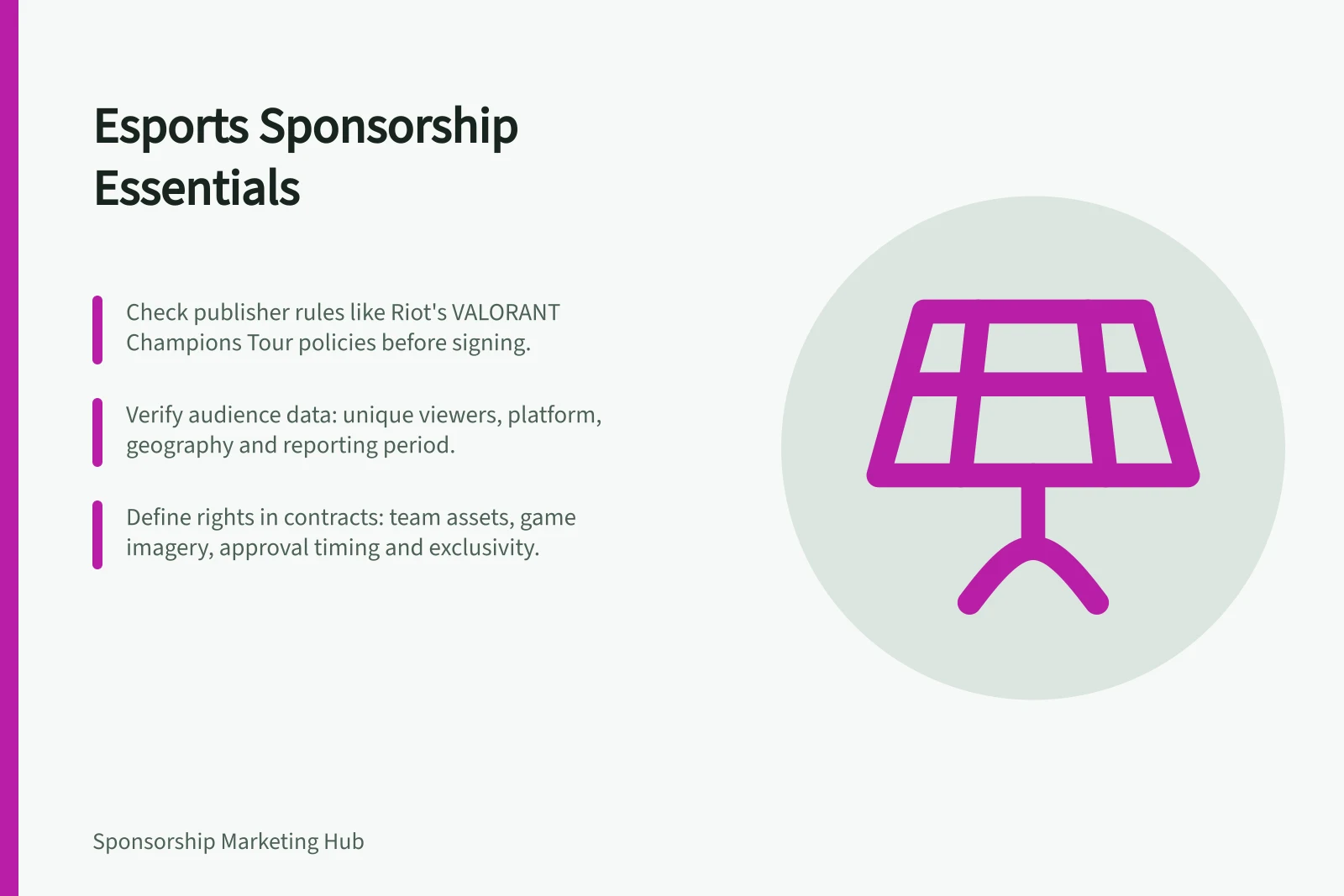
Ask who the sponsorship actually covers: a tournament broadcast, a team's channels, a player roster, a creator's stream or an in-person event. Request recent audience evidence for that property, including geography, platform, reporting period and whether the figures represent unique people, average concurrent viewers, views or followers. These numbers are not interchangeable.
Match the audience to the brand's real offer. A brand that can help players practise, connect or enjoy an event has a clearer activation route than one seeking a logo next to any gaming content. Do not assume all fans of a title want the same products or accept the same tone.
Examples of organisers and event brands include ESL, whose events include Intel Extreme Masters, ESL One and ESL Pro League, and DreamHack, which hosts tournaments and gaming festivals. BLAST and PGL also have named events in the tournament landscape. These names do not establish which rights a particular deal includes.
ESL FACEIT Group reported 287m social fan reach, 266m hours of EFG watched including China, and a 28% increase in viewership compared with 2023. These are group-level figures, not proof of an individual property's audience or sponsor delivery. Do not treat audience scale alone as a rights-fee benchmark.
Make the value proposition distinctive
A property’s unique selling point helps explain why a sponsor should choose it over other options. Consider what differentiates the property, how it fits into the marketplace and how it adds value to other programs.
The case should explain the value to the target sponsor. Connect the property’s distinctive strengths to what the sponsor can gain from the relationship, while keeping the claim grounded in evidence.
Map rights before creative
| Right | Question to settle |
|---|---|
| Tournament placement | Which broadcasts, stages, dates and territories are covered? |
| Team assets | Can the brand use the team mark and player likeness, and where? |
| Creator deliverables | Who approves scripts, disclosures and timing? |
| Game imagery | Does the organiser actually have permission to sublicense it? |
Get the deliverables, approval timetable, exclusivity category, make-good conditions and reporting in the agreement. A team deal may not include tournament inventory; a tournament deal may not give access to individual creators. Verify ownership before announcing a campaign.
Define each asset, term, territory, category and usage permission in the contract. Rights may sit with a tournament, team, player or creator, and a deal at one level does not automatically include another. Publisher intellectual property still needs permission.
Test capacity and timing
Assess how much time and resource the property can dedicate to securing sponsorship and managing commercial relationships. Confirm it can deliver the promised rights and reporting.
Set out when the sponsorship income is needed and what it must cover. Check that the proposed funding period matches that need.
Consider whether there are several appropriate income avenues rather than relying on one sponsor. A diversified plan can reduce reliance on a single commercial relationship.
Check publisher restrictions
Riot's VALORANT tournament policies include a section on sponsors and partners, and Riot's competitive-operations library publishes regulations for its esports titles, including official VALORANT Champions Tour competition rules. These examples are not a universal esports rulebook. Check the current title, circuit, territory and organiser agreement, and obtain written approval where the rules require it.
Separately, Riot's VALORANT Developer API Policy says monetised developer products cannot feature betting or gambling functionality and must offer a free tier of access, which may include advertising. This is a developer-product rule, not a substitute for checking the competition's sponsor terms.
Judge outcomes with the right denominator
Record what ran, where and when. Compare verified delivery with the contract, then examine relevant brand or business responses such as qualified site visits, community participation or sales where measurement permits.
Avoid treating a broadcast view as a person who saw the sponsor asset, or a social follower as a guaranteed impression. Include a process for community feedback and creative correction; a sponsorship can meet its media numbers and still feel out of place.
Use impact to support the decision
A strong proposal identifies the problem the property is trying to solve and explains how its work contributes to addressing it. Evidence of impact helps show why the property matters to a potential sponsor; a distinctive brand or ambitious plan alone does not establish that value.
Keep the impact case separate from campaign delivery measures. Evidence that a property's work has value can inform the decision to pursue a partnership, while contracted deliverables and measured responses show what the campaign achieved.
Treat the proposal as a go only if the audience fits, the seller can grant the promised rights, the relevant rules allow the planned use, delivery is resourced and results can be checked. If an element is unresolved, narrow the package or defer the decision.
In this guide
- Evaluating an esports property's audience evidenceAn esports sponsorship deck may combine viewers, views, followers and attendees.
- Separating tournament, team and creator sponsorship rightsA tournament, a team and a creator can all appear in the same esports scene while controlling different commercial assets.
- Checking game-publisher restrictions before activationGame publishers can control how their titles, marks, footage and competitions are used.
- Assessing a sponsor's fit with a gaming communityFit is more than a shared age bracket.